Professional Juicers Explained
Commercial juicers are essential if you’re planning to offer the freshest fruit or vegetable juice to your customers. Unlike blenders a juicer separates the juice from the pulp, producing wonderfully pure juices which are perfect for health drinks and cocktails. With so many different options out there though, it’s not always easy to know which juicer is suitable. This guide should help you decide.
SHOW ME JUICERSTYPES OF COMMERCIAL JUICER
Commercial juicers have one simple function: extract the maximum amount of juice from fruits, herbs, greens and vegetables - ideally as quickly as possible. To do this, there are three main types of juicing machine: citrus, centrifugal and masticating.
Manual versions are also available, often called hand juicers or juice extractors. These come in the form of hand-operated presses or the more traditional reamer.
Citrus Juicers
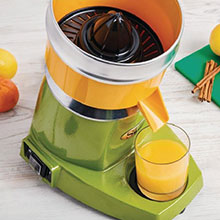
Using a similar method to traditional hand juicers, citrus juicers speed up the juicing process by using a powerful motor to spin a juicing cone. Juice is then channelled down into a glass or jug.
- Fast: once you’ve halved the fruit, it’s much faster to extract juice in comparison to squeezing by hand.
- Efficient: if you’ve ever needed to squeeze a large quantity of oranges by hand, you’ll know that it can be very hard work. Using a citrus juicer saves time, money and labour, making a much more efficient kitchen.
Good To Know: as the name suggests, citrus juicers are only really suitable for juicing oranges, limes, lemons and grapefruit. Fast-spinning cones can cause injury if not used correctly, so training is required before use.


Centrifugal Juicers
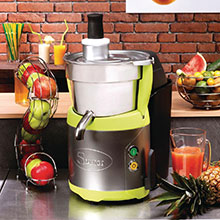
A centrifugal juicer uses a fast-spinning sieve and blade to separate the pulp and juice. This video demonstrates the typical functionality.
- No pre-cutting needed: can juice whole fruits and veg such as apples, pears and carrots - peel, skins, stalks and all.
- Super fast: rapid spinning means fast juicing. Perfect for when juice is produced on demand for waiting customers.
- Easy to use and clean: most centrifugal juicers are very easy to use. Just switch on and start juicing. Once you’ve finished, you can often simply lift out the sieve for cleaning.
Good To Know: not suitable for oranges and other citrus fruits. Due to their size and speed, centrifugal juicers can be quite loud when under load. In addition, some ingredients can produce a foamy finish, so you may need to sieve the juice to get perfect-looking fruit juice. Juice produced with a centrifugal juicer oxidises faster than slow juicers.


Reduced Price


Reduced Price

Masticating Juicers
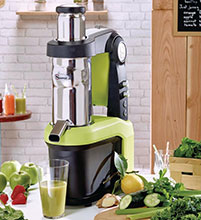
A masticating juicer, commonly called a slow press or cold press juicer, uses a slow-moving drill-like auger to squeeze and crush the juice from lots of different types of food. Traditionally, if you wanted a slow juicer, you had to choose between a small domestic version or a large unwieldy model which took up far too much space.
Thankfully, Santos has developed the only variable speed countertop version on the market, which delivers exceptional commercial performance without taking up too much space.
- Quiet: due to their speed, slow juicers are generally quieter than their fast-spinning cousins - ideal for sound-sensitive areas.
- Nutrient-rich: the unique mechanism doesn’t produce much enzyme-destroying heat during juicing, so food retains more nutrients in comparison to centrifugal juicers.
- Leafy greens: the drill-like auger ensures even cabbage, kale, spinach and other similar ingredients can be juiced with great results.
- Colourful juices: as the juicing is slow, the resulting juice retains more of the food’s original colour.
- Low oxidisation: as less air is introduced during juicing, slow-juiced food can generally be stored for longer.
Good To Know: most cold press juicers are single speed and take longer to juice in comparison to centrifugal models. Also, many juicers of this type require you to use a pusher to manually feed the ingredients into the mechanism, which can be quite time-consuming, especially if you are juicing bulk amounts.
Manual Juicers
Most hand-operated juice extractors are classified as manual juicers. If you’re short of space, or simply don’t do much juicing, a manual juicer can be a great choice for occasional use. Manual juicers can also be used as a backup or secondary option if you need extra juicing capacity.
VIEW ALL MANUAL JUICERSJuicer features to look for
Commercial or Domestic: if you’re only planning to do occasional breakfast juicing at home, a domestic juicer from Kenwood or Magimix is usually an excellent choice. However, any juicing on a professional scale will require something designed for the task. All juicers are listed with an expected output and warranty – try to match the output to your requirements.
Chute: all juicers have a chute where you feed the ingredients into the machine. The larger the chute, the bigger the ingredients can be. Often, the chute size is a good indication of the juicing capacity of the unit. Larger chutes also mean you can add whole foods such as apples and pears – dramatically reducing time and money in labour costs.
Power: almost all professional juicers are powered through a single 13A plug, so you won’t usually have to worry about hardwiring. In addition, every juicer will have a power rating, which is a good indication of both the performance of the unit and its running costs.
Lid/Presser: each type of juicer has a different method of compressing the food against the juicing mechanism. Automatic juicers usually have a pusher or lid, whereas many citrus juicers require you to push the fruit down by hand or crank. Models with lids help to improve safety and reduce the chance of juice wastage due to splashing.
Noise: if you’re juicing directly in front of customers, consider how much noise the juicer makes. A noisy centrifugal juicer might be fine for a busy shopping mall kiosk, but it could be quite disruptive in a relaxed rural café.
Frequently Asked Questions
What’s the difference between a juicer and blender?
A blender works by liquidising entire foods and is great for making smoothies and cocktails. A juicer separates juice from the fibre. More information about blenders can be found on the blender buying guide.
What type of juicer makes the most juice?
Slow press and centrifugal juicers all have roughly the same yield – there isn’t really much in it. However, per kilo of food, the Santos 65A cold press juicer yields a proven higher volume than centrifugal juicers. By the nature of its mechanism, it squeezes and crushes almost all the moisture from food, leaving pulp much drier compared to similar juicers.
What’s the best juicer?
The best juicer is the one that best fits your requirements. Even the top-end juicers aren’t suitable for every business. Try to match the output, noise and operation method to your business requirements.
What to do with juice pulp?
If you want to reduce your food waste, food pulp is a great way to reduce your costs too. There are far too many options to include here, but pulp is an increasingly popular ingredient in soups, salads and even veggie burgers or desserts. Food pulp is also compostable.
What about allergens?
Juicers (especially slow juicers) are often used to produce juice from allergen food categories such as celery. It’s important that if you include ingredients like this, make sure you’ve got all the signage and staff training in place. More information can be found on the allergen control guide.