
THE BENEFITS OF DICK KNIVES
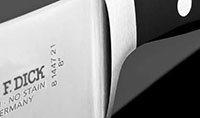
Friedr. Dick has a long and rich history that can be dated back to 1778 when Johann Friedrich Dick founded a file manufacturing workshop in Esslingen. From that day, the brand has seen much growth and many awards under their belt including product of the year awards and design awards. Friedr. Dick has been a manufacturer of high quality products in the following areas since 1778:
- Tools and machines for butchers
- Chefs knives and tools
- Machines for sharpening and grinding technology
- Files and tools for craftsmen and industry
- Circular knives
MANUFACTURING OF DICK KNIVES
All Dick products are manufactured according to traditional methods and by the most sophisticated production processes. Dick knives give many years of service to the user; they have been well planned and designed down to the smallest detail. Approximately 45 different production steps are required for each knife. The knives are forged from a solid piece of chromium-molybdenum steel, with the blades being specially hardened to at least 56 Rockwell. Great care and precision in the most important production processes, such as grinding and hardening, the quality control, as well as the steel alloys, lead to the high quality of Dick knives.
THE PREMIER PLUS
The Dick Premier Plus is a thoroughly forged knife, perfectly balanced and ergonomically shaped. The Dick manufacturing process fastens the blade and handle securely together, without a gap. This means that, in contrast to handles being assembled, even the smallest residues of food or liquid are kept away. Another important feature is the steel alloy and the hardening process. Dick knives are manufactured from the alloy X45CrMoV15, containing chromium for wear resistance, molybdenum for corrosion resistance and carbon for hardness, and each Dick knife is hand sharpened and honed before it leaves the factory.
Take the Premier Plus Chefs Knife 21 cm for example. The Dick website states:
- You can tell the forged knife by its bolster, the thickening between the blade and the handle, and by its continuous tang. Premier Plus was developed for ideal balance, edge retention and ergonomic properties.
- The stable back of the blade is used for fine gristle, for example, but also for breaking seafood shells.
- Small vegetables can be cut and minced with the front section of the blade.
- The curved blade design is ideal for both rocking cuts and slicing. This blade section allows cutting of almost all food materials.
- The back section of the blade is used for cutting tough and difficult materials, as it allows easy application of force.
- The wide blade side is also used for flattening and shaping prepared food. It also provides sufficient space between the hand on the handle and the cutting board.
THE 1905 SERIES
In 1905 the Swabian knife manufacturer Friedr. Dick developed a series of knives with aesthetic metal rings around the handle. These replaced the previously common rivets which were used to mount the handle onto the steel of the knife. The Dick knife series 1905 is captivating thanks to its exceptional appearance; modern materials and manufacturing processes are used today. The symmetrical steel rings are inseparably connected to the moulded handle, using a unique technology. The blade is well sharpened and the knife enjoys perfect equilibrium, with tapering at the tip. The blade is made of best quality German XCrMoVMn stainless steel, preferred by reputable chefs.
A finely dispersed martensitic structure is produced (with a hardness of over 60 HRc) thanks to a hi-tech tempering process at temperatures of approximately 1950° F and cryogenic treatment at temperatures as low as -310° F. Targeted tempering in several stages at approximately 392° F produces a unique, dynamic and sharp cutting edge. During this process, the hardness is carefully reduced to 55HRc. This hardness is required as it guarantees sharpness and retention of sharpness and also facilitates resharpening.
shop Dick 1905 Knives nowHOW TO CHOP...
Check out the other 'How To Chop' guides for more tips and tricks to help you in the kitchen.
How To Chop: The Rolling Technique
How To Chop: The Claw Grip Technique
How To Chop: The Hammer Technique
How To Chop: The Lever Technique
How To Chop: The Tunnel Technique