
How to Sharpen a Chef Knife
Keeping your chef knife sharp is one of every chef's most important kitchen maintenance tasks. Not only does keeping knives sharp make your job easier to complete, but it makes your job safer. If you are using a chefs knife that isn’t kept sharp, you have to apply more pressure than you would with a sharper blade, which makes the knife more likely to slip and cause injury.
shop chef knives nowWhat is The Best Knife Sharpening Angle?
When sharpening your kitchen knives you’ll want to achieve an angle that provides both a razor sharp, effortless cutting edge and a durable angle that won’t dull after every use. So what angle is best?
Sharpening your knives at a 15 to 20 degree angle will provide the best results when preparing food. This angle makes the blade edge sharp enough to provide a clean cut through foods whilst retaining durability through constant use. Most Asian style knives are honed to a 17 degree angle, making them slightly sharper than Western style knives, which are generally sharpened to 20 degrees. Asian foods are softer; therefore the blade edge can be sharper as it doesn’t need to cut tough foods.
Sharpening your knives at an angle lower than 17 degrees will make them super sharp, but will mean they will dull much quicker. The opposite is true for sharpening to angles greater than 22 degrees. Your knives won’t be as sharp but the cutting edge will last a lot longer.
View our video below to see this sharpening angle in action:
How to Sharpen Knives | Nisbets
How To Sharpen and Hone Your Chef Knives.TIP: When referring to the angle of the blade, the angle is for each side of the knife, making the total angle double. So if you sharpen your knife to 20 degrees, the total angle of the knife blade is 40 degrees.
How to Hone Knives Using a Steel
Traditional knife sharpening steels are suited to regularly honing knives that are already sharp to keep them in that condition. If you need to restore blunt knives use a diamond steel (industrial diamonds embedded in the blade provide a tough abrasive surface) or ceramic steels (not as abrasive as diamond - better for a finer edge).
- Place the steel tip down on a damp cloth - The damp cloth will stop it slipping
- Place the blade at the top near the sharpening steel handle - The angle between blade and steel should be 15-20°
- Pull the knife down and across the steel - The movement should be a slight arc
- Repeat this action on the back of the steel - This will sharpen the other side of the blade
- Repeat steps three and four at least five times - up to ten times will ensure maximum sharpness. It is very important to maintain the angle of 15-20° and to run the full length of the cutting edge along the steel from the hilt to the tip of the knife.
TIP: When your knives are fully sharpened, maintain a sharp edge by storing your knives in a knife block or magnetic knife holder to prevent them from dulling.
shop sharpening steels nowWhetstones & Sharpening Stones
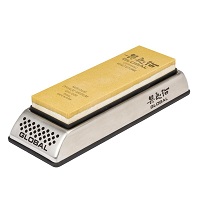
Whetstones, also known as sharpening stones, are considered one of the best ways to sharpen knives. Not all whetstones require lubrication with oil or water; check the instructions for the stone you purchase. They come in a variety of different grits (how fine or coarse the surface is) to help you sharpen and hone all kinds of knives.
100-250 grit whetstones are extremely coarse and are designed to reshape or repair blunt knives or chips. Because these whetstones are so abrasive, sharpening with them removes a lot of material from the blade, so they should only be used when your knives are blunt.
300-500 grit whetstones are still extremely abrasive, but are designed to help you quickly revive the edge of a dull knife.
1000 grit whetstones are the basic sharpening stones, perfect for sharpening any knife on. Japanese style knives, such as Tsuki, are best sharpened on a 1000 or 1200 grit whetstone, as they are often more delicate in construction that Western style knives such as Dick.
2000 grit whetstones are less abrasive than 1000 grit stones so will take longer to sharpen a knife with. They are designed for knives that are sharpened daily, helping you to keep a fine edge on the knives you use every day.
3000-4000 grit whetstones have a middle-of-the-road coarseness, acting as a buffer between sharpening and honing, rather than going from 1000 to 6000 grit. However, 3000 grit stones are the best finishing stones for boning knives.
5000 grit whetstones are the recommended fineness for sharpening western knives, such as Dick knives and Wusthof knives. 5000 grit and above are considered ‘fine’ and should not be soaked before use. Always read the instructions that come with your whetstone for information on soaking your sharpening stones.
6000 grit whetstones are the basic finishing stone, with a fine grit that gives you the perfect finish.
8000 grit whetstones are designed to give you the ultimate sharpness and most polished blade, suitable for chefs knives and knives used on non-fatty foods and ingredients.
Struggling to get the perfect angle when using a whetstone? The Masterclass knife sharpening guide gives you a perfect 20° angle when sharpening knives on a sharpening stone, speeding up sharpening times and giving your knives the perfect edge with ease.
shop whetstones nowManual & Electric Knife Sharpeners
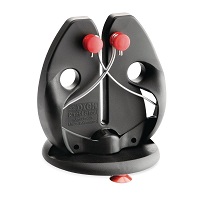
Hand held manual and electric knife sharpeners are perfect for quickly sharpening your knives to an exact angle, saving you time when it comes to keep your knives in top cutting condition. These sharpeners are also good for those who aren’t confident using a sharpening steel or whetstone or who have lots of knives and not a lot of time.
Some electric and manual sharpeners also have 2 slots; one for sharpening and one for honing. This makes them extremely efficient at bringing your dull knives back to life, whilst still being perfect for every-day honing.
shop knife sharpeners nowMichelin Star chef Sebastian Frank demonstrates how to use Dick sharpening steels, manual and electric knife sharpening tools to get the best edge on your knives.
How to Sharpen Knives with Dick | Dick knives
Learn how to sharpen Dick knives.Read More...
Check out our 'How To Chop' guides for more tips and tricks to help you in the kitchen.
How To Chop: The Rolling Technique
How To Chop: The Hammer Technique
How To Chop: The Lever Technique
How To Chop: The Tunnel Technique