
What is a Cold Room?
A Cold Room is the biggest piece of refrigeration used in a professional kitchen. Sometimes called a Walk-In, these are fridges or freezers which can hold many racks worth of stock, all securely stored in its own chilled or frozen room.
Unlike most other commercial fridges and freezers, cold rooms are generally immobile and require specialist installation. Typically, foods such as meat, dairy, fish and vegetables are kept in a cold room.
If you'd like to discuss your cold room requirements, please call 01173 459 539 (option 3 for cold rooms) to talk to a member of our team.
Why Buy A Cold Room?
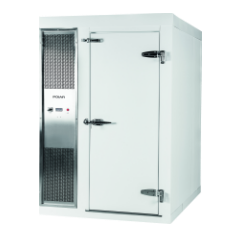
Cold rooms have the following major advantages over traditional upright or counter fridges/freezers:
- Large: a vast internal storage capacity. As the capacity is so large, cold rooms can be significantly more economical to run in comparison to smaller pieces of refrigeration - no need to buy, clean and maintain multiple units you’d otherwise need.
- Indoor or Outdoor: you can position a cold room almost anywhere there is space. Many cold rooms are located outside, leaving the rest of the kitchen free for cooking or food prep machines - perfect for sites with small kitchens. If installed outside, a cold room may require a weather proof roof to help protect it from the elements.
- Better distribution of stock: as food is kept on racking, it’s a lot easier to find and organise in comparison to other types of storage. When it comes to restocking your main kitchen fridge, the cold room makes the rotation and organisation of stock much easier.
- Secure and reliable: due to the potential value of the contents of a cold room, almost all models have features built-in to prevent both damage from the elements and theft. You can rely on a cold room to keep your food ready whenever it’s required.
- Convenient: whether you’re loading the morning’s delivery, or simply grabbing another box of tomatoes, cold rooms are highly accessible and easy to use.

Reduced Price

Cold Room Options
Once installed, walk-ins are hugely beneficial to businesses. However, there are a few important considerations and choices you need to be aware of before purchase.
- Chilled or Frozen: cold rooms are available as either a Walk In Fridge or Walk In Freezer. Some top-end versions can perform both functions.
- Integral or Remote: an Integral cold room has everything it needs built-in - often called “plug-and-play”. A Remote cold room pipes the hot air away from the kitchen, using a network of ducting. As such, remote cold rooms could take significantly longer to install. In addition, you may need to consult your local authority depending on where the ducting leads.
- Shelving: often called racking, this is where your stock will be placed during use. Shelving ensures food is easily accessible and maximises the amount of storage in the cold room. It also keeps food off the floor – vital for good food hygiene.
Depending on the size of the cold room, you can usually configure the racking how you like, so normally the shelving is sold separately. It’s important to note that a cold room is quite a harsh environment – moisture and food acids, as well as wear and tear can quickly cause shelving to rust or even fail altogether. Generally, the two most common types of racking for cold rooms are PVC plastic and anodised aluminium. Both are corrosion resistant and strong.
Shop Cold Room Shelving
- Ambient Temperature: easily forgotten, the Maximum Ambient Temperature is the highest room/external temperature that the cold room can operate in before the internal temperature is affected.
Most standard cold rooms can operate in temperatures up to 32°C, often called Climate Class 4. If you anticipate higher ambient temperatures, more powerful walk-in fridges and freezers can operate in external temperatures of up to 43°C (Climate Class 5). All Polar cold rooms are Climate Class 5. - Ventilation: all refrigerators work by transferring heat from the inside to the outside. Cold rooms are no different, except that there’s a lot more capacity which requires cooling. Therefore, walk-ins tend to require a sizable amount of ventilation around the unit.
There’s usually plenty of ventilation when a machine is installed outside, although if it’s installed indoors, you may need to consider what else is in the room and whether it could affect the performance of the chiller. If positioned in an especially confined area, an integral cold room may not have enough ventilation to hold temperature.
TIP: Did you know you can lease a cold room? For more information, see our Chef Leasing page.
Cold Room Installation
Once you’ve purchased a cold room from Nisbets, a specialist will be in contact with you to organise a Site Survey. The site survey is where an engineer visits your business to ensure the cold room is suitable for installation.
They’ll check the site measurements, any potential obstructions (such as manhole covers), ventilation and other similar aspects which could prevent installation or restrict performance. The cost of the site survey is included within the cold room price, so you won't usually be charged any extra for the service. If your business cannot accommodate a cold room for any reason, you’d receive a full refund in most circumstances.
Assuming that the survey is successful, the installation will be arranged at a time convenient for you. Depending on the location and size of the room, a typical installation only takes a few hours to complete and the room is usually available for use immediately afterwards. The following timelapse video demonstrates the build process.
Other Cold Room Features / Glossary
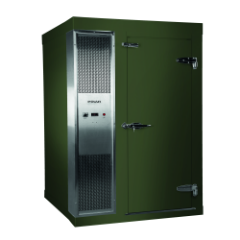
To make life easier, manufacturers of cold rooms often include useful features which improve its day-to-day operation and performance.
- Automatic Defrost is usually standard on most cold rooms. Off Cycle Defrost is where the refrigeration shuts off for short periods, whereas Electric Defrost actively melts ice, ensuring continuous, efficient refrigeration.
- Colour is mostly a cosmetic decision, although darker colours tend to be better for externally installed walk-ins. Outdoor grime can quickly be rather obvious on pure white units – not great if your customers can see the cold room.
- Emergency Escape functionality is built into all modern cold rooms. All include a simple internal button which opens the door. Others may include a panic button inside or “trace heaters” which prevent the door from freezing shut.
- Manual or Automatic Interior Lights are generally fitted as standard to make access and stock organisation easy.
- A Ramp can be used to help loading especially heavy or bulky stock on trolleys. Ramps also remove the trip hazard caused by the raised door frame.
- Rebated Doors close “flush” with the wall panels. This not only prevents potential theft (it’s almost impossible to jimmy the door open), it also helps to retain the internal temperature, thus saving energy. Almost all cold rooms are lockable and are designed to prevent break-ins.
- Self Closing Doors help to reduce running costs, as cold rooms have to work harder when the door is open. Also, if your arms are full of stock, there’s no need to close the door with your legs!
- Although most cold rooms are suitable for outdoor use, a Weather Proof Roof is usually recommended to help prevent a build-up of rain and other debris on top of the unit.
Frequently Asked Questions
How are cold rooms delivered? Will I need to store parts whilst I wait for installation?
Following the site survey, an engineer (usually at least two people) will be sent to fit the cold room. They'll bring everything they need, including the wall panels, so there's no need to worry about storing anything whilst you wait for installation.
Are cold rooms just for storing food?
No. You can put anything which needs chilling or freezing in them, although if you then subsequently need to store food it will need to be thoroughly sanitised and cleaned down. Common non-food businesses with cold rooms are florists, breweries, ice sculptors and pharmacies.
How are cold rooms powered?
Despite their size, cold rooms are actually remarkably efficient and usually only require a 13A plug to operate. However, some of the very largest, most powerful versions will need a hardwired connection. For more information about power types, see the Single Phase vs 3 Phase Power Guide.
Do I need extra insurance cover?
It’s always worth contacting your insurance provider to let them know of any significant changes like this. Although cold rooms are built to be reliable and secure, it’s important to have adequate cover.
I’ve ordered a cold room. How long before it’s installed and usable?
Assuming the site survey is successful and there are no unnecessary delays, Polar cold rooms are usually built and ready to use within three to four weeks.
Can a cold room be moved once installed?
Once in position, it's not usually advisable to move a walk-in. However, some modular cold rooms can be moved, although it's a good idea to get the experts to do it. Trying to move the unit yourself would usually invalidate any warranty.
View All Cold Rooms