
Buying Kitchen Knives
Finding the right knives is very important for the professional chef. This will be determined by numerous factors including the style of cuisine being prepared, frequency of use and the environment in which the knives are to be used. Over the years, most chefs will find a brand of kitchen knife they are most comfortable with as they try different knives out. While some knives can be used for a majority of tasks, many knives have specific purposes within the kitchen.
SHOP ALL KITCHEN KNIVESStyle of Knives
There are two common types of knife style, European (primarily German, Swiss or French) and Japanese. Knives of a European design are generally heavier in weight and created with the more substantial ingredients common to Western cuisine in mind. Japanese-inspired knives tend to be finer and well suited to the lighter components and more intricate style of Asian gastronomy.
Where To Buy Kitchen Knives?
You can buy kitchen knives from Nisbets. From paring and fillet knives to versatile chef knives and boning knives, we sell professional quality knives that can be used by seasoned chefs and budding enthusiasts alike.
Knife Blades
Kitchen knives generally either feature a curve near the tip, as in a cooks knife, or are straight for their entire length. The edge itself may be generally smooth, or may be serrated (have "teeth"). Scalloped blades have shallow indentations on the blade sides which help to reduce the problem of ingredients sticking to the knife. The point may differ in shape; most common is a sharp, triangular point, as in a cooks knife or paring knife, though the French point (also called "Sheepsfoot") is common in Santoku knives, and a round point is often found on long slicing knives.
Serrated vs Smooth Blade
The cutting edge of a serrated blade has many small points of contact with the material being cut. By having less contact area than a smooth blade, the applied pressure at each point of contact is relatively greater and the points of contact are at a sharper angle to the material being cut. A serrated blade helps when slicing items that are firm on the outside and soft on the inside, particularly bread or tomatoes. Serrated blades tend to stay sharper longer than a straight edged blade but they are difficult to sharpen.
Bolster
The bolster of the knife - the heavy joint between the handle and blade - adds strength, creates balance and gives heightened control. Not every knife has a bolster, with stamped blades and Japanese style knives typically foregoing this feature for a lighter feel.
Stamped
Stamped blades are cut to shape directly from cold-rolled steel, heat-treated for strength, then ground, polished, and sharpened. Although most often associated with more economical knife ranges, several popular knife brands such as Global use stamped and heat-treated blades in their premium knives. Stamped blades are often identified by the absence of a bolster.
Forged
Forged blades are made in an intricate, multi-step process, often by hand. A chunk of solid or powdered steel alloy is heated to a high temperature, and pounded while hot to form it. The blade is then heated above critical temperature, quenched and tempered to the desired hardness. After forging and heat-treating, the blade is polished and sharpened. Forged blades are typically thicker and heavier than stamped blades.
Rockwell Hardness Rating - HRC Rating
It’s obviously important to understand the quality of your knife, including the strength or hardness of the metal it’s made from. This is defined by a Rockwell or HRC number. Knives with a higher rating (around 60) are stronger, harder and can be sharpened to a finer edge, such as our Tsuki range. By comparison, lower rated knives are less likely to chip and can be sharpened more quickly, but are also likely to lose their edge more quickly and require sharpening more often. These knives are generally also more affordable, but should still have a Rockwell Hardness Rating of at least 50.
Types of Knives
An all-purpose knife tends to be the favourite tool of any chef, and naturally ends up doing the most work. However, having a great quality knife designed for each specific kitchen task ensures best results and maximises productivity. A poor choice of knife can be costly. Whether filleting fish, dicing through vegetables or slicing thin, delicate cuts of meat there is always a knife available that is best suited to the job in hand. To own a selection of these knives means saving time and effort in food preparation, as well as increasing comfort and safety.
Chefs / Cooks Knife

A chef’s knife or cooks knife is usually the workhorse of any knife set. They generally have a sharp pointed blade with a length of between six to fourteen inches. A modern cooks knife is designed to perform well at many differing kitchen tasks, rather than excelling at any one in particular. It can be used for mincing, slicing and chopping vegetables or meat and disjointing large cuts.
Fillet Knife
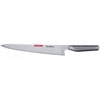
The fillet knife has a flexible and thin blade, which makes it perfect for reaching places that are difficult with a standard cooks knife. The flexible blade structure and thin metal make filleting knives ideally suited for more delicate tasks such as removing skin or fillets from fish. Fillet knife blades average between four and nine inches in length.
Boning Knife

A boning knife is primarily designed to remove bones from cuts of meat. They can used with an overhand or underhand grip, the latter often utilised by butchers when jointing hanging cuts. They feature a thin blade with a sharp point, usually between five to seven inches long. A stiff boning knife is good for beef and pork, and a flexible one is preferred for poultry and fish.
Bread Knife
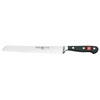
Bread knives are usually between six and ten inches and feature a serrated edge to break through hard outer crusts. Also useful for pastry where a plain edge would struggle to cut through the outer layer without tearing or breaking the product.
Carving and Slicing Knives
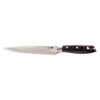
Between six and fourteen inches in length, carving and slicing knives are used to slice thin cuts of meat including poultry, roasts, hams and other large cooked meats. They can feature either a serrated or plain blade, with the smooth edge of a salmon knife particularly suited to producing very fine slices of fish. A carving knife is much more slender than a cooks knife, enabling it to carve thinner, precise portions.
Paring Knife
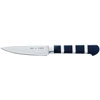
A paring knife is a general purpose knife with a plain edge blade that is used for small intricate work like peeling and coring. A good paring knife usually measures between three and five inches on the blade.
Tomato Knife
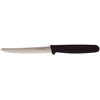
A tomato knife is a small serrated kitchen knife designed to slice through tomatoes. The serrated edge allows the knife to penetrate the skin quickly without crushing the flesh. Many tomato knives have forked tips that allow the user to lift and move the tomato slices.
Utility Knife
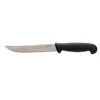
A utility knife is used for general or utility purposes. A utility knife is between a chefs knife and paring knife in size, about four inches and seven inches in length.
Santoku Knife

The Santoku is a general-purpose kitchen knife originating in Japan. Its blade is typically between five and eight inches long, has a flat edge and a sheepsfoot blade that curves in an angle approaching 60 degrees at the point. The knife performs well at slicing, dicing and mincing. The Santoku blade and handle are designed to work in harmony by matching the blade's width/weight to the weight of blade tang and handle.
Turning Knife

An essential tool for creating chateau potatoes, the turning knife is ideal for shaping, trimming and peeling all types of fruit and vegetables. The classic turning knife has a distinctly curved blade (often referred to as a bird beak blade) and tends to range in size between two and six inches.