
Fancy a Career in Catering?
Experienced hospitality and recruitment entrepreneur Pete Cann, who co-founded Bristol-based catering recruitment business Back-2-Front in 2009, and Dan Gibbons, senior chef lecturer at Shrewsbury College, discuss the pros and cons of a career in catering.
Could catering be the right career choice for you?

Ask any experienced catering professional about the advantages and disadvantages of a career in the catering and hospitality industry and they are likely to outline that it’s hard and demanding work and the financial rewards are scant in the early years.
But they’ll also probably go on to tell you that careers in the kitchen or in other busy hospitality service industry positions can be very satisfying and rewarding if you’re willing to put in the time and effort and show a passion for the profession.
Data from our Nisbets Pulse Survey Spring 2017, which recorded the thoughts of over 800 catering businesses and professionals on the industry outlook, found that concerns over the difficulties of recruiting talented staff was a major concern for over a quarter of the respondents.
So whether you are a school leaver, a casual catering worker looking for a more permanent role or simply considering a career change, catering with its diverse workforce and employment opportunities could be just the ticket for you.
Dan says: “It’s a hard trade. I was told that at a very early age and I think it is important that we do not dress it up in any other way. If you stick at it, though, it can be very rewarding in a way other professions struggle to match. You can go anywhere in the world and you meet and work with some fantastic people.”
Why should I consider a career in catering?
Long-Term Employment Opportunities

One of the most attractive things about the catering industry is probably the long-term employment opportunities it offers at a time when the future economic outlook is uncertain. Hospitality is one of only a few growth industries in what has been a difficult and unpredictable economy in recent years.
According to figures in a British Hospitality Association Oxford Economics report: The Economic Contribution of the UK Hospitality Industry (2017), the sector has performed well above the average in employment growth and labour productivity growth over the last three years.
Recent data from Visa’s Consumer Spending Index also showed that spend in UK hotels, restaurants and bars during July 2017 rose by 6% year-on-year in a climate when spend was down overall and uncertainties over Brexit remain.
Career Progression
The British Hospitality Association describes the catering industry as a ‘true meritocracy’ where people are promoted on merit and hard work is rewarded by rapid career progression.
Pete says: "A lot of the big chains and companies run their own management programmes and are keen to fill positions from within. It is a great industry in terms of opportunities for career mobility.”
You Meet Great People and it's Fun!
Catering employees are generally expected to work anti-social hours or shift work due to the nature of the business. That will usually include work in the evenings and at weekends – but that doesn’t mean you don’t get a chance to enjoy yourself!
Pete says: “You are working as a team to service large numbers of people in stressful situations and that fosters a real camaraderie. I always found it a really sociable environment and I certainly had lots of fun in my younger years!”
Will Brexit Affect The Catering Industry workforce?
The British Hospitality Association (BHA) suggests that thousands of businesses are faced with the prospect of having to drastically reduce their dependence on EU workers.
European workers currently make up around quarter of the industry’s workforce, and businesses may have to start looking closer to home to fill their vacancies should any separation deal reduce access to the European labour market as part of the UK’s withdrawal from the European Union.
Pete says: "Around two-thirds of the chefs currently on our books are EU nationals. It is already difficult to recruit really good quality chefs. We’ll definitely need more good young UK chefs and hospitality professionals coming through to compensate for any possible changes that come about as a result of Brexit.”
The findings of a recent survey carried out by accountancy firm KPMG forecasts that businesses will have to find an additional 60,000 new employees on top of the 200,000 already required every year to compensate for ‘natural churn’.
Is catering a ‘career of choice’?
A number of trade bodies and associations are running campaigns aimed at changing the perceptions of the general population towards working in the catering industry.
Campaigners are looking at ways to improve everything from training and engagement to salaries and hours in order to persuade targeted groups such as the unemployed, returners to the labour market and the next generation (16-24 year olds) that catering can be a ‘career of choice’.
The BHA have recently submitted a ten-year plan to Downing Street outlining proposals to look closer to home in an attempt to provide workable solutions to fill the void in the event of restricted access to the EU labour market.
What do I need to do to embark on a catering career?
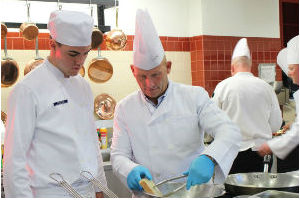
So you like what you’ve read so far and have decided that catering might be a career for you. What do you do next? There are currently 290 catering colleges in the UK that offer full-time educational courses leading to professional qualifications in all aspects of catering and hospitality.
The most widely recognised are run by awarding bodies City & Guilds, which encompasses the National/Scottish Vocational Qualifications (NVQ/SVQ) and Vocationally Recognised Qualifications (VRQ) programmes, and the Business and Technology Education Council (BTEC).
The courses can be taken at various levels from beginners to advanced and are all designed to teach students the practical skills in preparation for employment in the industry.
Dan says: “Hospitality students spend a limited amount of time in the classroom. The courses are heavily-weighted in favour of practical and hands on experience. A restaurant that serves the public is also a fantastic facility to have because it gives the students experience of working in a pressurised hospitality setting.”
Several courses can also be taken on a part-time basis or as part of an apprenticeship scheme. Results from our 2017 Pulse Survey showed that 17% of over 800 business owners and industry professionals had set up apprenticeship schemes in response to difficulties in filling positions.
TIP: If you are interested in one of these courses you should contact a careers advisor or your local Further Education College for some advice on the course that best suits your career ambitions.
How do I find a job in catering?
How businesses in the catering industry recruit was another topic covered in our 2016 Pulse Survey. The survey found that ‘word of mouth’ is a ‘very effective’ method of recruiting all types of staff with 41% of those asked.
Dan says: “Word of mouth is how I got started in catering. My neighbours had a relationship with a local hotel and told me of a weekend pot wash job that was going when I was 14. I was inspired over the next couple of years to pursue catering as a career and enrolled at college when I left school.”
TIP: Ask any friends and family you know who may work in the industry about possible job openings. Social media, company websites and other online advertising companies, catering recruitment agencies and print material are other methods that businesses use to find staff.
A word of warning
Jobs in the catering industry are very rewarding and provide great opportunities for career progression. But success requires passion and a willingness to work hard.
Pete says: "I don’t think the way the TV glamourises the industry really does us too many favours. It can be quite a pressurised job when you are short of staff or an unexpected party arrives at your restaurant expecting to be fed at short notice. The hours are also pretty long so it is one of those industries that you need to have a passion for what you do.”
Things you’ll need
Whether you’re thinking about working in the kitchen or planning to make your mark front-of-house, there are some essentials that the catering professional can’t be without.
Visit our student mini-shop page to find a great selection of knives, clothing and front-of-house accessories that will help you be fully prepared for life both in the college kitchen or in the professional restaurant.