
Choosing the Right Cookware Material
Cookware comes in hundreds of shapes and sizes in order to perform the hundreds of different cooking tasks that take place in a kitchen each working week. But it isn’t just the shape and size that needs to be looked at, the material also plays a huge part in a pans performance.
SHOP ALL COOKWARE NOWAluminium Pans

Aluminium is still a firm favourite in the kitchen due to the fact that it is cheap, doesn’t corrode and is a great conductor of heat. It is these combinations that makes aluminium a good pan for boiling and on cost grounds is suitable for very big pans such as stockpots. While there are many advantages to aluminium, there are also disadvantages like any material. Aluminium can react with acidic food to give flavour taint; it also can’t be used on induction hobs and is prone to sticking when food is fried. While cheap aluminium pans are made from a single sheet of metal, the best professional aluminium pans have a thicker base to spread the heat more evenly. Medium-duty aluminium pans with a base thickness of 3mm to 4mm are suitable for open-top cooking ranges, but with the more intense heat of a solid-top range or for hard use, a heavy-duty pan with a base of 7mm will perform better.
Stainless Steel Pans

Stainless steel is an alloy of metals including steel, carbon and chromium, and have risen in popularity with hotels and restaurants. This is because it doesn’t tarnish, it is easy to clean, hygienic, hard-wearing, has a non-reactivity with either alkaline or acidic foods. It is also less prone to sticking than other metals. As with aluminium, the base of the pan will be layered; this normally takes the form of a three-layer sandwich with stainless steel on the bottom, aluminium in the middle to give good conductivity and stainless steel on top. Some top of the range pans will have up to seven sandwich layers.
Cast Iron Pans
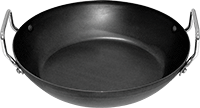
Cast iron cookware is perfect for a wide range of cooking applications, from searing steaks to frying meats and vegetables. Cast iron can withstand extremely high temperatures and has excellent heat retention properties, making it an efficient and practical material for use in commercial and domestic kitchens. Cast iron was commonly used in the 20th century, but its popularity fell during the 1950’s due to the introduction of cheaper materials and synthetic non-stick coatings, such as aluminium. However, the potential, quality and durability that cast iron has to offer has seen its popularity and use rise year-on-year since, with it becoming the go-to choice for many amateur and professional chefs. A non-stick coating is achieved by seasoning the pan with oils, which also makes it a healthier option as there are no chemicals used to create the non-stick surface.
Copper Pans
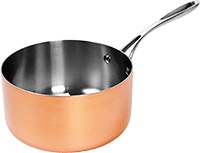
Copper pans have always been a popular choice for their attractive appearance and ease of control thanks to their excellent conductivity. The traditional construction would be copper for the conductivity lined with tin to protect the food from contamination from the copper. These days, copper pans will be found lined with stainless steel as it provides the conductivity with the style of copper. One downside of copper pans is their solid metal handles, which can get far hotter than the tubular handles found on stainless steel or aluminium cookware.
NON-STICK PANS
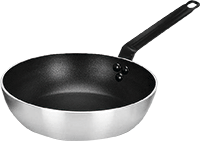
Non-stick pans are a must in any kitchen as they are perfect for frying delicate foods like fish. Care needs to be taken with non stick as the coating can be damaged if not properly cared for. The two main causes of damage to the non-stick coating are using metal utensils and overheating. While normal frying is done at 200°C, flash frying over a fierce heat can send the base temperature over 250°C causing splitting.
TRI WALL PANS
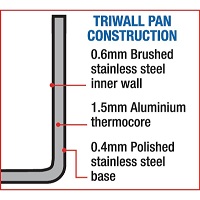
Tri Wall cookware is constructed with multiple layers on metal that work together to increase heat conduction, spread heat evenly. As the name suggests, Tri Wall cookware is made from 3 layers; a layer of aluminium sandwiched between an outer layer of brushed stainless steel and an inner layer of polished stainless steel. This is called Thermocore and makes the pans extremely good at conducting heat whilst remaining easy to clean and safe for all foods. Vogue Tri Wall cookware is accredited by the Craft Guild of Chefs because of its superior cooking qualities, making it perfect for use in domestic and commercial kitchens.
Cooking Dishes
Stoneware
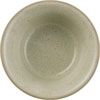
Although stoneware is more commonly thought of for presentation dishes, in actual fact it is perfect for cookware due to its high temperature tolerance. Stoneware is chip-resistant and has many uses within the kitchen including the refrigerator, oven and microwave. It is made from a strong clay that is fired to a high temperature (about 1196°C) and becomes vitreous. This material will withstand a temperature range of –20°C to +250°C, making them suitable for oven to table use. Most are dishwasher friendly and all can be placed in a microwave.
Enamelled Cast Iron
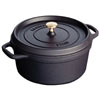
Enamelled cast iron pans and casserole dishes are made great for strength, conductivity and heat retention. They are coated both inside and out with an enamel paint which is baked onto the cast iron at high temperature to give a smooth cooking surface and prevent rusting. Like stoneware, these are perfect for oven to table use - especially as they come in a multitude of different colours.
Glass
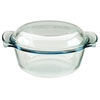
Borosilicate glass, such as Pyrex, is safe at oven temperatures. Glass is versatile in that some can be taken from refrigerator or freezer to the oven and will not absorb food odours. The clear glass also allows for the food to be seen during the cooking process, and it retains heat well. However, it can't be used on the stovetop as it can’t cope with stove's temperatures, and it can be subject to thermal shock, and can break.
Earthenware
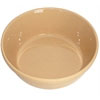
Earthenware is a white and porous clay that is fired at a low temperature of 1,046°C and is one of the oldest materials used in pottery. Earthenware usually called ‘ceramics’ or ‘ceramic ware’, is decorated, glazed with a clear coat and fired. Although considered cost-effective, it is not as tough or water-resistant as other ceramics. Earthenware has to be glazed or it will absorb water, making the cleaning process difficult. Some earthenware are vitrified; this is when a ceramic body is fired to a temperature of above 1,210°C; the body of the material melts together. This means the material becomes non porous so neither water nor bacteria can seep into the product. Earthenware absorbs heat slowly but retains it well, which is ideal for slow-cooking in the oven. As heat is conducted evenly, earthenware cookware has a high heat-retention. It is also non-reactive, allowing any ingredients to be used without damaging the cookware or creating an adverse chemical reaction that affects the taste of the dish.
Porcelain

Porcelain is a ceramic made by heating raw materials, generally including clay in the form of kaolin, in a kiln to temperatures between 1,200 °C and 1,400 °C. The toughness, strength, and translucence of porcelain arise mainly from the formation of glass and the mineral mullite within the fired body at these high temperatures. Porcelain crockery differs in the price range; while some can come cheap, some is expensive. It has good resistance to ‘thermal shock’, which is why it is often used as oven to tableware.