
Colour coded chopping boards
Chopping boards are an essential kitchen component for any chef. Whether you’re cooking in a professional capacity or at your home for friends and family, choosing the right chopping board is an important decision with such a broad range of materials on offer. Thankfully, colour coded chopping boards are here to make things simple for all of us. It’s true that not every home needs a full set of these but we recommend having at least two boards to separate your raw and cooked foods to help minimise the risk of cross contamination. Naturally, we advise that every professional kitchen has at least one full set.
shop chopping board sets nowGuide to colour coded sets
In a professional kitchen, colour coded chopping board sets are used to help employees to quickly identify which chopping boards should be used for a specific food group. There are recommended colours for each group:

Which Colour Chopping Board to use with which Food Groups?
- White chopping boards - bakery and dairy products
- Yellow chopping boards - cooked meat
- Brown chopping boards - root vegetables
- Red chopping boards - raw meat
- Blue chopping boards - raw fish
- Green chopping boards - salad, fruit and fresh vegetables
The use of colour coded equipment is widely adopted in professional kitchens, extending to other kitchen items such as knife sets and cleaning equipment. These colours are only recommended but as yet are not enforced by law. Laminated wall charts are available as a quick reference for employees, to help them see which colours are suitable for each task at a glance. These wall charts are clearly visible and easy to read.
It’s a common myth that plastic boards are more hygienic than those made of wood, glass, granite, marble, bamboo or composite materials. In reality, each can prove to be a serious health hazard if they are not properly cleaned. Recommended washing and drying processes are the only way to ensure they are safe from cross contamination.


Preventing allergic reactions in your kitchen

As many catering professionals will have noticed, people’s dietary requirements are getting more complicated. Gluten-free diets are increasingly popular, whilst Coeliac disease is more widely understood. At the same time food allergies are increasingly common, with UK admissions to hospital due to food allergies increasing by more than 500% since 1990.
This means more and more customers need to know exactly what their food may have been in contact with. If you can’t tell them definitively, then they will take their business elsewhere! Colour coding your kitchen gives both you and the customer confidence that their allergy or other dietary requirement is being accommodated safely.
This means that as dietary requirements continue to become more complicated, catering for them effectively will become an increasingly important (and profitable) concern. This is reflected in the introduction of a new purple chopping board, specifically for use with ‘free-from’ ingredients such as gluten-free produce, and emphasises the importance of established colour coding techniques.
Plastic Chopping Boards
There are two main materials used to make plastic chopping boards:
- High-density polyethylene (HDPE) - These are the most commonly used chopping boards in commercial kitchens thanks to their durability. The high-density mould creates a strong board that is more resilient to knife scratches and warping. Hygiplas boards come in 2 thickness sizes: 12mm and 25mm, giving you a thicker board that suits constant use in restaurants, cafes and other commercial kitchens.
- Low-density polyethylene (LDPE) - This is a lightweight plastic that are designed to be replaced often, helping you to cut out food contamination. These boards can warp and bend under high temperatures so it's best to removing them from dishwasher before the drying process begins.
A plastic chopping board should be replaced when its surface is deeply scored. The main reason for this is that bacteria like to grow in these ‘scored’ areas, and when transferred to food can cause serious illness. Even after washing a chopping board thoroughly, bacteria have a habit of clinging on to these grooves and because of this, you cannot be certain that it is safe to use again for food preparation.
Plastic and acrylic chopping boards are non-porous, and are easier to clean than wooden chopping boards. However, they can ‘warp’ if they are left in a dishwasher during the drying part of the cycle, so they bend slightly. This makes an unstable platform for cutting and therefore causes more risks when using a knife. To avoid ‘warping’, take the plastic board out after the wash cycle and allow it to air dry. A warped chopping board must be replaced as it is dangerous to use a sharp knife on an uneven surface due to the risk of it slipping and causing a serious injury.
Wooden Chopping Boards
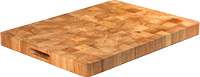
Wooden chopping boards are able to resist bacteria better than plastic chopping boards. However, laminated wood boards are not usually dishwasher-safe and are therefore more difficult to clean thoroughly. Although wood can also be ‘scored’ to leave grooves, they can also crack, exposing more areas for bacteria to latch on to. Therefore, wooden chopping boards should be replaced if they are cracked, scored, or if the seams between the boards begin to separate. Wooden chopping boards should not be submerged in water, as they absorb liquid easily, causing them to warp and leave cracks as they dry out.
How to Season a Wooden Chopping Board
Wooden chopping boards should be seasoned, a form of conditioning which stops them drying out and cracks appearing. Mineral oil is highly recommended for this, as vegetable oils will turn rancid over time. When applying the oil, rub along the grain of the wood until the board does not absorb any more oil. You can then wipe the remaining surface oil away with a paper towel. Seasoning your chopping board will seal any gaps in its surface and help protect it from moisture. You can also use this technique to revive an old board; maybe it’s one which has been passed down through the family and just needs a little ‘TLC’. For best results, do this once a month to keep the chopping board in good condition and increase its lifespan.
Wood is still the kindest material on the cutting edge of a knife, as it is a natural product which does not blunt the edge as quickly as other materials. To clean the board, wash it in hot soapy water and use a sanitizing spray. Heavy soil and scuff marks can be removed with a steel scraper. Air drying is the most efficient way to ensure the wooden board is clean, dry and ready for use. When looking for a wooden chopping board, tight-grained hardwoods are best as they are more durable, offering higher resistant to deep knife cuts.
Article: How can you make sure your wooden chopping or serving boards are thoroughly clean and safe for serving food? Read our full length guide to keeping wooden boards hygienic and food safe.
Associated risks
Chopping boards are a typical breeding ground for harmful bacteria and need replacing more often than many believe. Anything that comes in to contact with your food can cause contamination by spreading germs, which is one of the most common causes of food poisoning.
Research by the Global Hygiene Council has found that almost half of all frequently touched items in the home are contaminated with harmful bacteria, including E Coli. Of all items in the home, the chopping board harbours more bacteria than anything else for two main reasons:
- They are often not cleaned properly
- They are not replaced regularly
E Coli is commonly found on raw meat, poultry, fish and unwashed fruit and vegetables. The harmful bacteria are easily spread via chopping boards which have not been thoroughly disinfected. The potential risks for us are so high because just one single bacterium can become millions within a matter of hours. Colour coded chopping boards are the simplest and most cost effective way to combat these harmful bacteria and maintain a healthy kitchen.
Hints and tips
- For all chopping boards, avoid using a tea towel to dry them as this can spread germs easily and also leaves fibres behind on their surface (a process known as ‘linting’). It’s best to let them dry out naturally but if time is a factor, use paper towels instead for best practice.
- Depending on your food preparation surface, thinner chopping boards can sometimes slip: an obvious danger when knives are used. Minimise this risk by using one of the following methods:
- Use a damp cloth or paper towel underneath to help it stick down.
- Putty or ‘tak’ can also be used to secure the board and keep it in a fixed position.
- A rubber shelf-liner can also keep the board in place and can be easily washed after use.
- Bacteria thrive on moisture. Keeping your chopping boards upright on a chopping board rack will allow decent airflow between them and ensure they are safely clean, dry and ready for use.