The Shape of Plates
Guest Writer: In this guide, Industry expert Ross Jones takes you through the impact that plate shapes can have on food plating and presentation. Ross is the brand manager for Chinacraft, the industry's leading resource for the latest in tableware trends.
One of the most emotive processes in designing a new menu is choosing the tableware to present the dishes on. The right dish can enhance your hard work and have the diner ‘cooing’ before they’ve even picked up their knife and fork – the sight and smell of your dish can mean that it is deemed a success before it’s even been tasted. Win-win for you and the customer. If you’re fortunate it might even lead to photos being circulated on social media, enticing friends and family to book themselves a table with you over the coming months.
However there’s the other side of the coin. The wrong choice. Pairing the wrong china with your dish can, at best, leave the food to do most of the talking. At worst it can leave the food to take care of all of the presentation element and you’d have to be very confident, or very foolish, to not want to present on china that will stage your dish as well as possible. Learn more in our guide on The Art Of Food Plating.
To make this important decision all the more complex, there are a myriad of options when it comes to choosing your china: different shapes, colours, textures, sizes and (importantly!) different price points all impacting the decision. Manufacturers want to cater for every quirk that might exist in the market, and the result is 200+ page catalogues just for ceramics. If you’re lucky enough to have a holiday booked and want some pool-side reading then you might just about be able to work your way through a couple of manufacturers brochures. However, if you don’t have a week in the sun booked (or you do but you’d prefer not to spend it reading tableware catalogues!), then hopefully I can save you a few hours research with some basic summaries of the options available to you.
In this article, we'll address shapes. There are only so many things that you can do with clay when designing a plate you can eat off, so mercifully we only have 5 basic shapes: round, square, coupe, triangular and oblong. Each shape has its own features and benefits, depending on what you are trying to achieve.
You can also browse for crockery inspiration using the Chinacraft e-catalogue.
Browse the Chinacraft catalogueTriangular Plates

Triangular plates are the least commonly found. They lend themselves to one single item being held at one end of the plate - usually the central component of a dish - with a larger expanse at the other end of the plate for complimentary items. A good example would be a slice of cake for a dessert held at one end of the plate with the larger expanse used for fruit to balance the dish with colour and texture.
Triangular plates can be sharp, angular lines or they can be softer, rounded edges such as those found in the Olympia Kiln range in the image to the right. Either way though the aesthetics of a triangle shaped plate add a modern yet playful twist to a dish and so fits well with casual dining outlets or lunch menus (think soup & sandwich or coffee & pastry).
Shop All Triangular Crockery NowSquare Plates

Square plates such as the Royal Bone China plate to the right were once the epitome of modern chic dining, but they have been superseded by the casual dining trend that has proliferated in recent years. Don’t let that put you off though; when a particular shape wanes in popularity therein lays its strength. If you want to do something different to what all of your competitors are doing, then square plates might just be the best option.
The style traditionally lends itself well to Asian foods but the straight, clean lines of a square plate convey an essence that works well with almost any cuisine. The play off with square plates has always been that the shape doesn’t lend itself particularly well to edge-chip resistance, and often manufacturers won’t offer the same guarantees that they do on round equivalents. Most manufacturers will offer ‘rounded squares’ to nullify a little of this effect.
Shop All Square Crockery Now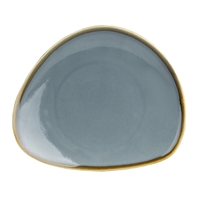
Reduced Price


Round Plates
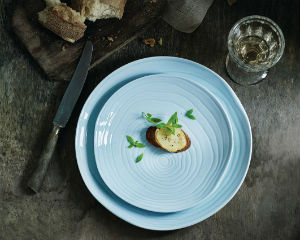
Round plates are the most common and universal shape, and they’re popular for a reason. They aren’t linked to any trend or fad and so don’t go out of fashion, they naturally frame the food, they’re a convenient shape for dishwashers and back of house storage, and they are least likely to polarise any individual opinion on the finished dish.
Selecting round china will eliminate one part of the decision process for you and allow you to focus instead on colour, texture and price (ease of manufacturing means they tend to be a lower price point than other shapes). The vast majority of professional kitchens choose round tableware. The Pillivuyt Tekk plate to the right lends itself to the natural trend but retains the ability to frame your dish without drawing attention away from your food.
Shop All Round Crockery NowRectangular Plates
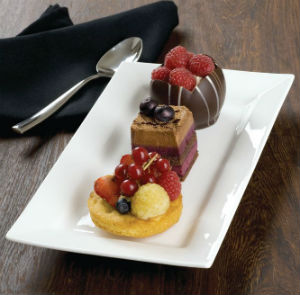
Rectangular plates include oval and rectangular pieces; basically whenever the dish is longer than it is wide. It’s worth noting that it’s very rare that you’ll see a kitchen use rectangular plates exclusively. The shape doesn’t lend itself well to some dishes: for instance, can you imagine risotto served on an rectangular plate? However, rectangular plates can enhance a dish too: for example, a trio of desserts on a rectangular plate such as the Lumina Fine China plate to the right provides the perfect presentation. Rectangular plates can also be complementary to another shape that is also being used on the table.
Certain foods almost always suit rectangular plates (fish & chips, burgers, sharing platters) and there’s no right or wrong in choosing what to pair them with. Whether you pair softer, oval shaped oblongs with the soft lines of round plates; or straighter-edged, rectangular oblongs with the more defined outline of a square plate, you're adding a real depth to your food plating presentation. There is also the option to do the opposite and create a contrast to change the way your menu is presented.
Shop All Rectangular Crockery Now
Coupe Plates
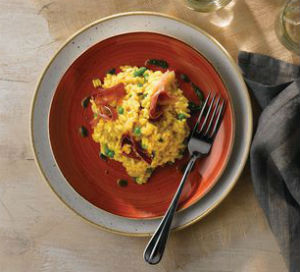
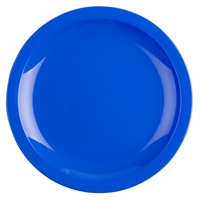
Coupe plates are flat, rimless plates but with a slight concave that is sometimes referred to as a flat bowl. The minimalist aesthetic of a coupe plate delivers a blank canvas that will naturally draw the eye to the food rather than what it’s being served on. By making the plate as inconspicuous as possible, you're making sure the star of the show will always be your food.
The Coupe design is particularly popular for coloured or textured china where it allows the colour or texture to be the key design feature rather than the shape of the plate.
This is particularly the case with Churchill's Stonecast range as seen to the right which adds a warmth to your food with its colour and rustic style. The colours of the super vitrified stonecast range have been chosen to reflect the changing seasons and each piece is individually painted to achieve the maximum effect.
Time to Go Shopping
Ultimately you needn’t agonise over these decisions. The choice has to satisfy personal preference as much as anything else and it’s rare that someone doesn’t have a natural inclination towards one or two of these shapes. Hopefully, knowing the fundamentals of each shape will at least give you a starting point and you can start selecting your crockery with a little more confidence.
Shop All Crockery NowArticle: For more information on choosing crockery, try our companion guides Choosing The Right Colour Plates and Choosing The Right Size of Plates.