How Do I Reduce Costs in a Restaurant?
You can reduce your restaurant costs by carrying out an analysis of your outgoings to identify where you can make cutbacks. It is important to make sure impact on standard and quality of service is minimal whenever you put in place a cost reduction plan. Read on for our top 20 cost-reduction tips for big long-term savings on your outgoings.
Why are Cost-saving Measures Important For A Restaurant?
With restaurant profit margins under pressure more than they’ve ever been, there’s never been a more important time to find ways to save costs.
According to UK Hospitality in 2024, the restaurant landscape has reduced by over 4,000 sites since 2018. Increased food prices and utility costs have placed pressure on margins.
The implications of the 2024 Autumn Budget also mean there will be challenges ahead for the hospitality industry. Changes to hospitality rates relief, employer National Insurance contributions and minimum wage changes are estimated to cost the sector approximately £3.4 billion.
How Can I Make Savings at My Restaurant?
Click the links below to quickly jump to a specific section.
What Are the Highest Restaurant Costs?
Prime Costs
Prime costs are the cost of labour and cost of food combined. They will account for over half of most restaurants outgoings. Prime costs are where you can exert most control to make savings for positive long-term changes on bottom line. To keep your business in positive financial health, prime costs should be no more than 50-60% of total turnover.
Rent and Utilities
Rent is the amount you pay for occupancy in your building. Utility costs pay for the use of gas, electricity, water, internet, telephone and other essential services. Premises costs include business rates, insurance costs and building repairs. Whether you own premises or are renting a business space, you should aim to keep these combined costs between 5-10% of turnover.
DID YOU KNOW:In 2024, 60% of property sales have been leasehold, with an average premium of £72,000.*
*The Hospitality Christie & Co Benchmarking Report, 2024
How to Control Food Costs in a Restaurant
1. Reduce Stock Levels

Simply buy what you need. It’s obvious, right? Yes, but everybody knows it’s more complicated than that when you’re rushed of your feet in a busy kitchen. But with avoidable food waste in the hospitality industry running into hundreds of thousand tonnes per year, finding a little more time to control your inventory could return some huge savings. Buying in bulk may save you some time and money, but, you’re literally throwing those savings in the bin if you have a high value of stock unused past its shelf life. Most restaurants will usually hold no more than seven days of stock to minimise the occurrence of spoilage.
2. Use Order Tracking Sheets
Keeping track of what you are buying and when you are buying it is the first step towards taking control of your food costs. Purchase and usage records will give you an accurate idea of how much you need to buy each time you order to reduce the amount of product at risk of spoilage. You will also build up a list of useful historical data that will indicate the likelihood of spikes in demand. This allows you to make quick adjustments to your order quantities to keep your stock at an optimum level.
3. Check the Weight of Your Deliveries

Again, another obvious practice, but it can be tempting to skip time checking deliveries when you’re hard pressed before or during busy service. But spending a few minutes checking quality and quantity of your produce could save you a fortune. It's not a slur on the honesty of your suppliers, rather an acceptance that mistakes are all part of business from time-to-time. All you need is a good quality set of platform scales in your receiving area to avoid being the one paying for those mistakes. A thermometer is also an essential for checking the temperature of perishable goods received. Check tins for dents that could be an indicator of spoiled contents, while fragile items such as eggs are also prone to breakage.
4. Negotiate a Better Price with Your Suppliers
Negotiating the best prices with your suppliers is a crucial part of any food service business cost-saving strategy. Make sure to research a few different suppliers before you start negotiating. You need to be sure that lower prices doesn’t equate to lower quality of produce or lower standards of service. Most suppliers will be open to lowering their pricing structure in return for your loyalty. It costs them less to keep a customer than it does get a new one, so a generous trade discount is usually offered if you enter into a Service-Level Agreement (SLA). Your part of the deal is to buy a significant percentage of produce from that particular supplier. Try to agree a cost plus fixed price deal to protect your margins against wild fluctuations in food prices. These happen due to changes in import costs as dictated by the strength of the pound and other changing economic factors.
5. Secure Your Stock
It’s a sensitive subject to talk about, but the reality is that theft of valuable stock does happen. In the US, a National Restaurant Association report suggested that as much as 75% of all inventory shrinkage is attributable to it. It pays to secure some of your most valuable items, such as expensive cuts of meat or fish along with alcohol in lockable fridges, freezers and drinks coolers.
How to Reduce Menu Costs in a Restaurant
6. Balance Your Menu Costs
Costing a menu is essential in an industry that operates on pretty thin margins. Luckily, costing a menu is a simple process. First, you need to know exactly how much every dish on your menu costs to make (direct costs). Include seasoning, cooking oils and garnishes in those calculations. Then you must decide whether your target market will pay the retail price when you have added a sustainable mark-up of around 30-35% on top. This may seem excessive, but profit margin can be as little as 5% per dish once you add in indirect costs (labour, equipment, energy). The most cost-efficient menus have a good mix of low cost/high margin dishes (rice, pasta) alongside high cost/low margin dishes (expensive meat and fish).
7. Portion Control and Recipe Sheets

Portion control and recipe sheets are widely-used in multi-site food service retailers where consistency of product is critical in satisfying customer expectations. They are no less important in small independents or fine dining establishments as a way of minimising food costs. There is little point in spending lots of time costing your menu, if your chefs are not aware of the exact quantities of ingredients needed. Even adding small excesses of ingredients could add up to affect your bottom line by thousands of pounds over time. Luckily, there are lots of kitchen utensils and tools such as measuring jugs, measuring spoons, and portioners to help with accuracy in the kitchen.
8. Monitor the Cost of Complimentary Items
There are some things that your diners will expect to receive gratis. Items such as bread, butter, condiments, garnishes, napkins and complimentary chocolates are all grouped into something known as the Q Factor. The cost of these complimentary items is usually added to the price of the entrée. Think about the complimentary items on your menu and work out how much they are adding to your food costs. If it is more 10%, there could be some potential for cost savings through more careful controls.
How to Reduce Labour Costs in a Restaurant
9. Let Demand Guide Scheduling

It's a tricky balancing act for most restaurant owners, managers and head chefs. Understanding the peaks and troughs of demand is the key to working out optimum levels of staffing for maximum productivity. You don’t want team members to be twiddling their thumbs, but understaffing leading to a loss of business through poor quality service can also eat into your costs. Managers spend around 25% of their time compiling staff rotas. To speed up the process, you could use software programmes that forecast demand to help you organise the most cost-effective and productive rotas.
10. Have a Team of Casual Workers
You’ll need a team of salaried employees to maintain a consistency of service, but whether you’re a small independent or a major hotel chain, it pays to have access to casual workers. Casual workers are less costly that salaried employees when compared in like-for-like roles. They are perfect to call in when there are seasonal spikes in demand, plus you are also under no obligation to offer work when peak periods end. The increased labour cost is usually covered by extra revenue generated by the increased footfall.
11. Retain Staff, Increase Labour Productivity
Contributing factors to this high turnover include long working hours, elevated stress levels, and understaffing. Recent studies by Fourth indicate that the UK hospitality sector continues to experience significant challenges in productivity, largely due to high staff turnover rates. In 2022, the industry faced an average monthly employee departure rate of 5.7%, with pubs experiencing the highest turnover at 8.4% in April and 7.1% in June. This persistent turnover highlights existing productivity issues within the sector.
TIP: Try researching the industry to compare the salaries you are paying with outlets of a similar size. Could you attract top talent by paying more?

Staff members that feel engaged, are better trained, better paid, and see opportunity for career progression will stay with you longer. Over the long-term you’ll save money on recruitment and the knowledge, skills and experience retained will increase productivity across the business. It’s important to remember that you’ll need staff engaged with any cost-saving strategy if it is to be successful. Keeping your staff happy is central to retaining the services of your staff for longer. Some ways to keep your staff motivated include:
- Work-life balance
- Approachable management
- Career Prospects
- Company Culture
You can find out more about staff retention strategies in our how to retain catering and hospitality staff guide
12. Bring Outsourced Services In House
What services are you paying third-party businesses to carry out for you? Is it workable to bring any of these services back in house? Perhaps you could invest in some accounting software and take care of your basic restaurant accounting yourself. Do you have cleaning contractors? What about social media and marketing? Cost saving is usually the primary reason any business will bring outsourced services back in house. You need to be sure that you have both the manpower and expertise to do so – otherwise it could end up being less cost-effective than outsourcing.
How To Reduce Restaurant Waste

13. Restaurant Waste Management
The cost of food waste to the hospitality industry is estimated to top £600 million per year, with over 60% coming by way of food prep and spoilage. A report by Too Good to Go, a tech start-up that designed an app to reduce hospitality food waste, say the average restaurant could save £2000 per year if the amount throw away was reduced by as little as 20%. Between £150 and £1700 could also be slashed from waste management costs.
With new legislation coming in on 31st March 2025, workplace recycling rules are changing. The UK Government's new Simpler Recylcing regulations require all businesses with 10 or more full-time employees to separate ‘relevant recycling waste’ into four main streams:
- Food waste
- Mixed recycling
- Paper and card
- General waste
The Rubbermaid Slim Jim four-stream bin bundle is the perfect solution to assist you in separating recyclable waste. You can also reduce general waste by:
- Increasing the amount of waste you compost or recycle.
- Reviewing your existing waste management arrangements. Diverting a greater proportion of waste away from landfill could save you money. Collections of waste specifically for recycling or composting are cheaper. Separating your waste is easy with specific compost bins and recycling stations.
- Reducing the volume of your waste by using electric waste compactors. Kenburn, a UK-based waste management solutions company, say that compacting rubbish for reduced collections could shave up to 20% off disposal costs.
- Monitoring the amount of waste returning on customer plates. Excess amounts of food on returned plates could be an indicator that portion sizes need reviewing. In the UK, 41% of participants asked in a recent survey blamed oversized portions for leaving food on their plates.
You can reduce food prep waste by:

How to Save on Restaurant Equipment Costs
14. Protect Your Glassware and Tableware
The cost of replacing equipment can be considerable. Getting the most from your investments by extending service life adds up to a significant cost saver. Breakages are an occupational hazard in fast-paced hospitality environments, but there are some processes you can implement that will save you money. Lots of busy bars opt for toughened glass because it is around five times stronger and has greater resistance to impacts that would shatter standard glass. Other ways to reduce glassware breakage costs are to use compartment dishwasher racks and glass jacks to limit the risk of breakage during warewashing, storage and transit.
There are also a few things that you can do to extend the service life of your crockery:
- Buy plates and dishes that are designed to withstand the wear and tear of busy commercial catering environments
- Look for products that are super/fully vitrified with chip-resistant rolled edges, like the whiteware available from leading brands Athena and Olympia.
- Try and get products that come with a lifetime edge chip warranty. You’ll find lots of items covered amongst our huge and varied selection of commercial crockery.

15. Clean the Oil in Your Fryer
This simple tip could save you a staggering amount of money. A small-to-medium-sized restaurant spends around £6000 per year on buying, using and disposing oil. The cheapest way to extend the life of your oil involves manual filtering with a skimmer. You could also add Frypowder to your oil, while regular use of a filtration system could cut spend on oil by up to 50%. Extending the life of your oil also means your fryers need to be drained less frequently. Less frequent drainage means less cleaning of the tanks, which could save you up 20% on cleaning chemicals. Envirowise, a UK-based drainage specialist, say that's a saving of between £200 and £600 for a food service business spending up to £3,000 on chemicals per year.
TIP: Regularly cleaned beer lines reduce the amount of product that is lost to spoilage.
16. Save on Cleaning
Having the right cleaning equipment to tackle those bacterial hotspots will reduce the amount of time you need to complete a high quality finish. Most restaurants use cleaning chemicals designed for use in commercial settings. Commercial cleaning chemicals tend to be lower cost per ml than those brands aimed predominantly at the domestic market. They can also be purchased in larger sized units for even better savings. You can maximise value even further by using a dosage control system. This will help you to use the right amount of chemical to water when dilution is required and will ensure overuse wastage is also reduced. Restaurants using dosage control could potentially use up to three times less chemical than those businesses that don’t.
17. Invest in Quality Catering Equipment
Sometimes paying a higher upfront cost will save you money in the long run. If you’re investing in equipment, it is advisable to scan customer reviews, read buying guides or seek advice from peers to make sure that you get the right equipment to meet your specific needs. Check that your equipment comes with a commercial warranty and read the terms and conditions to be sure that if anything goes wrong your items will be repaired or replaced without additional cost during the specified period. Think about leasing options or low-rate finance if you need to spread the cost of investment to help you retain a positive cash flow.
TIP: Save money on equipment costs by keeping an eye out for special offers and clearance items
.How Do I Reduce Restaurant Energy Costs?

18. Restaurant Energy-Saving Tips
Restaurant and other food service operators use around 2.5 times more energy per square metre than other commercial businesses. Utilities typically account for between 2% and 6% of total sales. The cost could be reduced by upwards of 15% with some moderate changes to working practices.
- Regularly clean and service heavy equipment such as ventilation units and extractor fans for up to 50% reduction in energy consumption. Servicing your boiler once per year, for example, could reduce the cost of running it by around 10%.
- Refrigeration and cooling is the single biggest user of energy in commercial kitchens. The European Union estimates the potential for savings could be as high as 60%. Buy energy-efficient refrigeration (energy rating ‘A’) and carry out regular cleaning using products such as condenser cleaner. Use thermometers to check refrigeration display is showing accurate temperature. An inaccuracy of +1°c could mean an extra 2-4% in running costs.
- Use high speed cooking if suited to your food service offering. Commercial microwaves use up to 80% less energy than traditional ovens, while accelerated cooking machines also offer savings when compared with conventional ovens.
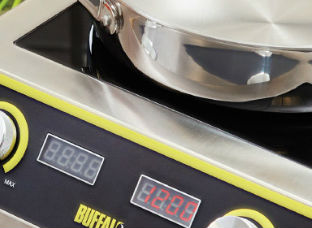
- Use induction cooking instead of traditional hobs. Induction cooking is up to 50% more efficient because magnets are used to provide heat instead of elements. More energy is diverted directly into the food, and units also turn off automatically when pans are removed.
- Reduce the temperature of your dining room. Turning your thermostat down by 1°C could result in a saving of up to 10%. Make sure your diners are still comfortable!
- Make sure dishwashers and glasswashers are fully loaded for each wash cycle.
- If you’re not using it, turn it off! Make use of stickers and signs to remind chefs and waiting staff to turn things off after use and at the end of every shift.
- Replacing traditional lightbulbs with energy efficient LED light bulbs could save you £6 per bulb per year, according to Energy Saving Trust. Energy efficient light bulbs consume 80% less energy than traditional bulbs and last around 3-5 times longer.
- Shop around to find the best value energy supplier.

DID YOU KNOW: The cost of energy to prepare one restaurant meal ranges from 23p to 45p, according to energy provider Gazprom.
How do I Reduce Restaurant Business Rates and Rent Costs?
19. Business Rates Relief

The amount you pay is dependent on the rateable value of the commercial premises you are operating out of. The amount is set by a Valuations Officer. It is free to appeal if you think the amount set by the officer is incorrect. Contact the UK government online to check that your rateable value is correct. You may also qualify for small business relief if the rateable value of the commercial property is below £15,000. You need to contact your local council to assess your eligibility.
20. Ask Your Landlord for a Rent Reduction
Sometimes you can be making all reasonable attempts run a sustainable business, but the state of the market means you are still struggling to make ends meet. In these instances, it might be possible to ask your landlord for a rent reduction. They may or may not be sympathetic to your plight, but there is no harm in making an enquiry. It is particularly pertinent if there is a noticeable decline in trade across the market or within a particular community. Landlords may be prepared to negotiate because the last thing they will want is a vacant property that few businesses will be keen on renting in a stagnant economy.
ARTICLE: Are you paying too much for your business insurance? Read our business insurance guide to find out whether you have the right package and to discover possible ways to reduce your premiums.
Landlords are also mindful of the money they could lose if they are renting to a struggling limited company that is forced to go into administration. Between the start and end of 2018 the amount of companies that chose to enter a Company Voluntary Agreement (CVA) increased by 143%. Landlords can be forced to settle for only a small percentage of any money they are owed under such arrangements. Seek professional advice from commercial property agents or solicitors that specialise in property for advice on how to renegotiate the cost of your lease.