
How To Write On A Chalkboard
Writing on a chalkboard is an important skill and isn't as easy as it looks. Following these simple steps is an excellent way to improve your sign writing:
- Use high quality chalk pens
- Choose the right width of pen
- Prepare your chalk pens properly
- Plan your design
- Space your board with a pencil
- Select your style carefully
- Don't retrace your working
- Let your chalk dry
- Use both sides of the board
- Clean your chalkboard properly
Ready to give these hints a try? Why not check out our handy video?
How to neatly write on a chalkboard
Writing neatly on a chalkboard or commercial blackboard will help to attract passing footfall. You want to stand out from the competition and pique the interest of people walking past, so making your writing easily readable and vibrant is essential.Alternatively, choose your perfect chalkboard now:
Shop all commercial blackboards1. Use high quality chalk pens
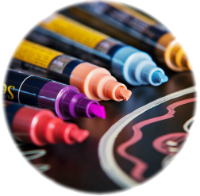
People's chalkboards often suffer when their pens aren't up to the job. If you find yourself asking ‘Why are my chalk pens so runny?' it's probably because cheap chalk markers can have thin, runny ink which is impossible to use neatly and cleanly. Their pump mechanisms can also easily dry or become clogged, making it impossible to write legibly and consistently.
For outstanding quality and reliability, you need the right tools. Securit are liquid chalk pen pioneers who have been perfecting their chalk markers for thirty years. With dual-use reversible nibs, high quality pump actions and a huge range of colours available, these chalk pens are designed to give bright and long-lasting chalk displays.
2. Choose the right width of pen
Liquid chalk pens are available in a range of sizes, with 2mm, 6mm and 15mm nibs all giving different sized lines and suiting different sizes of chalkboard. For most boards, a 6mm nib is perfect for writing in a clear but well-defined way.
By comparison, 15mm pens are a brilliant way of drawing bold titles or borders, but are difficult to use with control on smaller boards. If you want to finish your chalk writing with precision, 2mm pens are perfect for fine detailing and finishing illustrations.
3. Prepare your chalk pens properly
It's important to pay attention when preparing chalk board pens. Pumping the nib of pens too much results in a soaked tip, making the pen less accurate. It may even drip or leak onto your board! Having shaken the pen vertically a few times, place the nib against paper and press up and down until you see liquid chalk reach the end of the tip. When your pen has left a mark, it's time to stop.
TIP: Securit chalk markers have reversible tips, offering a chisel or rounded nib. Chisel tips are great for calligraphic writing and finer detail, whereas rounded nibs give consistent lines and are good for outlining and shading. Choose your nibs before priming!
4. Plan Your Spacing

Many boards look disappointing because the person writing hasn't given their layout anywhere near enough thought. It can be handy to plan your blackboard's layout on a piece of paper beforehand. In fact, it's one of the key steps in how to create a brilliant blackboard display.
Sketch out your design, including any artwork. If you can fit the writing onto a sheet of A4 with a pencil, it will probably be fine for your board, but remember that your chalk pen will be much thicker!
TIP: Are you trying to write on a pavement board? Always close your A frame and place it on a flat surface in order to write on it. This prevents the ink running and makes it less likely that you'll slip when leaning on the surface.
5. Space Your Board With a Pencil
Once you've finalised your design, use a ruler and pencil to lightly trace a template onto your board. Faint horizontal lines will keep your writing level, whilst this is a fantastic opportunity to check everything fits as you expect it to!
TIP: Using an ambitious title font? Tracing individual letters in pencil and going over them in chalk can be easier than ‘going freehand' with your marker.
6. Select your style carefully
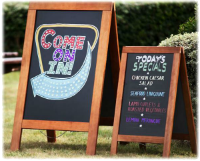
Sometimes it's better to use colour selectively. White chalk is easier to read, whilst selected splashes of colour draw customers' attention. In fact, some local authorities even recommend this, with Bristol City Council recommending that ‘strong colours enhance in small quantities; too much and the effect is overpowering'.
Looking to add softer colour palettes to your chalkboards? Why not try pastel chalk pens? The subtle colours will help bring your boards to life without ever overwhelming your displays.
Once you've planned your board and selected and primed your pens, you're ready to write!
7. Don't retrace your working
Write slowly and consistently. Liquid chalk will dry as you work, meaning that different sections of your board will appear slightly different shades. This is perfectly normal and you should ignore it, attempting to retrace or go over wet chalk will result in running and may ruin your work! There will be plenty of time to touch up your work when it is dry.
TIP: If you need to re-prime a pen, do it on a piece of paper well away from your board.
8. Let your chalk dry

Most liquid chalk will be dry enough to see the overall effect in roughly sixty seconds. This is when you can add to shading, retrace parts of a letter and make sure colours are even.
NEVER use one colour of chalk on top of another. Your nib will become contaminated and ruin the colour of your marker. If you're using your chalkboard outdoors, give the chalk as long as possible t dry and become weather resistant.
9. Use both sides
If you're using an A frame sign on a pavement or walkway, customers are likely to be approaching from both sides. This means only marking one side is presenting a blank side to half of your customers. Oops!
10. Clean your chalkboard properly
We've all seen blackboards with a milky, dusty layer behind the text. This is often caused by bad cleaning technique. Use a specially designed blackboard cleaner to remove all text with a microfiber cloth and allow your blackboard to dry fully before storing. If it isn't completely clean, repeat with a fresh cloth. For best results, most blackboard cleaners should be sprayed directly onto the board and left for roughly 30 seconds before applying the cloth.
TIP: Olympia boards are made of melamine to ensure that no chalk is absorbed into the surface. This uninterrupted and smooth surface is easy to clean and is perfect for creating fresh displays time after time.
Shop all commercial blackboards