
How to Prevent No Show Reservations
How To: Industry writer Jackie Mitchell talks to Si Toft from The Dining Room in Abersoch about the amount of customers who reserve a table and fail to show up, as well as what you can do to help prevent it at your restaurant.
Customers who book a table and then don’t show up are a constant problem. Last year ResDiary, the online reservation system, found ‘no shows’ were costing the industry £16b a year.
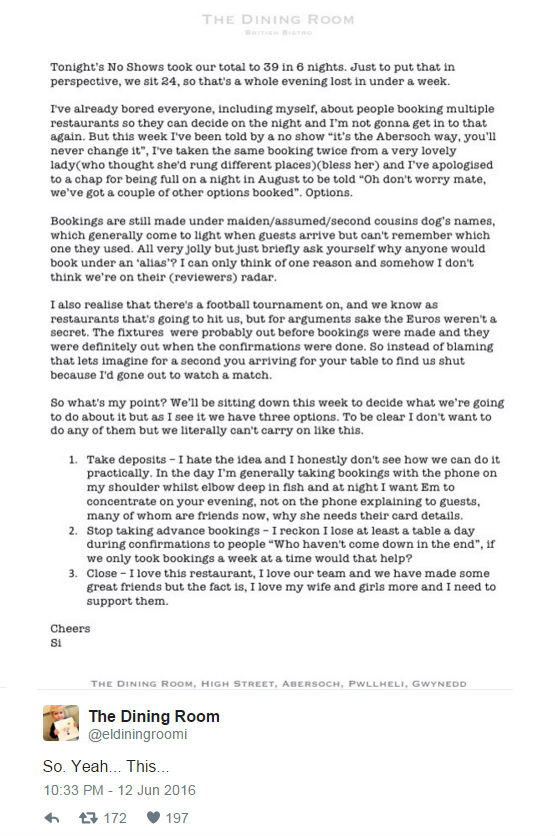
Si Toft, who runs The Dining Room restaurant in Abersoch, Wales, was so exasperated about “no shows” that he wrote an ‘open letter’ on Twitter expressing his frustration. In the letter he says there had been 39 ‘no shows’ in six consecutive nights. “Just to put that in perspective, we sit 24, so that’s a whole evening lost in under a week.”
The restaurant has been in its current premises for four years. “The problem of no shows has been more noticeable since then,” says Toft, “and a constant problem for the last few months. The worst was the weekend when I posted the Twitter statement.”
The Dining Room's Open Letter:
The SA’s advice includes making water freely available and to remove sugary drinks from the menu; serve freshly prepared food, not ready meals; provide children’s cutlery and serve a portion of veg with every meal.
Why Do People Treat Restaurants in this Casual Way?
Toft thinks people don’t have a clue about the knock on effects. “We phone them to confirm the table and we send them a text. After 20 to 30 minutes if they haven’t turned up, we’ll call them. If it’s a 7:30pm booking there’s a good chance we can fill it with ‘walk ins’. But we stop getting walk ins after 7:30pm, so if someone doesn’t turn up for a 8pm table, it’s a real problem. I won’t know until 8:30pm when it’s too late to fill the table. If we don’t get an answer on the night, we’ll phone the next day.”
When Toft phones people he receives all sorts of excuses; one person even laughed down the phone. “Sometimes there’s a bit of remorse but because they see we’re busy they assume we will fill the table. We’re often fully booked, but when we have no shows, we lose money.”
People getting the date wrong is a common problem. “Even with email and text, they might have the wrong date or they turn up a week early. We’re too small for online bookings.”
People Keep Their Options Open
One of the problems, as Toft highlights in the Twitter letter, is that people like to keep their options open and so book several restaurants so they can choose on the night. “It’s not pleasant to be thought of as an option,” Toft says. “A friend who’s a taxi driver hears people talking in the back of the cab saying they have booked several restaurants and will decide which one to go to. They book the return taxi and say they will let him know which restaurant to pick them up from. They’re so open about it, they don’t think it’s bad.”
Making reservations using an alias is another issue Toft has to deal with. “This generally comes to light when guests arrive but can’t remember which name they used,” he says,” or you notice there are some bookings with the same phone number, but a different name. An alias probably means they’ve been a ‘no show’ before.”
Another contributory factor are major sporting events such as football tournaments. As Toft says in his letter “The fixtures were probably out before the restaurant bookings were made and they were definitely out when the confirmations were done. So instead of blaming that, let’s imagine a customer arriving for their table to find the restaurant shut because I’d gone out to watch a match.”
So, What can be Done About No Shows?
At the end of the Twitter statement, Toft says he may have to take deposits, stop taking advance bookings or in the worst case scenario, close.
Deposits are impractical at The Dining Room. “Someone phoned to buy a gift voucher over the phone – it took over eight minutes to do that,” he says. “So imagine how time-consuming it would be to take a deposit for everyone over the phone. It would mean a member of staff would have to be taken off the floor to deal with it.”
The Dining Room could stop taking advance bookings at all, which would mean they could lose out on group bookings for special occasions. “Taking advance bookings mean we can plan the tables. We have long rows of tables, so we can split them up according to the bookings,” he says.
What Advice is There for Restaurants on Dealing with No Shows?
“It’s a massive problem. Everyone’s in the same boat – it’s something that affects all restaurants. It depends on the type of establishment. The restaurant down the road doesn’t take bookings – it’s a relaxed, informal place. People get a pint at 6pm and join the queue. For us, we need to have bookings.”
On a positive note, as a direct result of the Twitter letter, things have got better. The following weekend, there were only a couple of no shows – a table of four and one of two. “By normal standards that was very low,” he says. “People have been phoning to apologise saying they didn’t realise the effect. One called in at the restaurant.”
He feels the Twitter letter has done the trick so far. “It’s got people’s attention. I’ll see how things have panned out at the end of the summer. Hopefully it won’t be necessary for me to take any action,” he says.
Advice from the National Restaurant Association
- Put the booking confirmation in writing
- Make the call
- Make it easy to cancel
- Credit cards
- Reward reservations
Send a text or email to confirm. This works as a reminder for your customers if they forget where they've booked, so be sure to include a phone number and address as well as the time of the reservation and for how many. Online bookings systems can do this automatically for you.
A phone call, text or email the day before the reservation to remind customers also provides the customer with a good impression of your customer service.
Ensure customers can cancel easily by phone, email or text. Making it easy to cancel means you will have time to try to fill that spot with another booking.
Some restaurants require credit card numbers when customers make reservations and charge for no shows. Even if you don’t routinely ask for deposits or credit cards numbers, you might choose to for holidays and for parties of six or more. You can also sell advance tickets for special fixed price meals such as New Year’s Eve.
Consider offering incentives to customers who honour their reservations.
By Jackie Mitchell