
Japanese Chef Knives
Japan's unique food culture has helped to shape the distinctive appearance and high precision blade of a Japanese chefs knife. These knives are incredibly diverse, as are their production techniques. With so many available, high performance, durability and ease of sharpening make essential features to look for when deciding which one to buy.
SHOP JAPANESE CHEFS KNIVESWhat is a Japanese Chefs Knife?
Japanese chefs knives tend to be lighter than other knives because most are stamped and not forged. They also typically have little or no bolster and the edges are sharpened more steeply. However this steel is harder, giving them a sharper edge for longer. There's over 1000 years of history and tradition embodied in each blade, including the knowledge gained from ancient samurai sword making techniques. One of the main differences with Western style knives is their rigidity. A typical Japanese boning knife, for example, is less flexible than its Western equivalent giving confidence when riding along bones, cartilage and joints to separate different cuts of meat.
Japanese Chef Knives vs. German
There are two commonly known blade shapes on the continent, French and German. German-style knives are more deeply and continuously curved along the whole cutting edge, while the French style has an edge that is straighter until the end and then curves up to the tip. A little further afield however, another blade type is becoming increasingly popular in the west: Japanese chefs knives. Quite different from their European counterparts, Japanese blades tend to be thinner and made of harder steel to compensate, allowing the chef to perform very precise and delicate incisions.
Reduced Price


Reduced Price


How To Use a Japanese Chefs Knife
Though there are many types of Japanese chefs knives, the all-purpose chefs knife or 'Gyuto' is known for its ability to slice and dice with ease. The shape of a typical Japanese chefs knife lends itself to some more specific actions as well. These knives are best handled so that the spine of the knife and butt of the handle is facing towards you. The gyuto's pointed tip is condusive to intricate cuts, such as filleting fish. There are many types of Japanese chefs knives however, and each has its place in the kitchen.
How To Sharpen a Japanese Chefs Knife
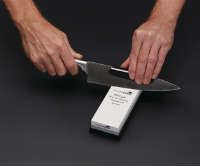
Japanese knives are generally able to be sharpened to a much finer angle at the cutting edge because of the harder steel. This contributes to a sharper knife that slices and cuts easily and put less pressure on the muscles and joints in the hand. The best way to sharpen a Japanese chefs knife is with a commercial grade whetstone.
Firstly, submerge the whetstone in water to remove all the air bubbles. After 5-10 minutes, and no sign of bubbles the whetstone will be ready for sharpening. Only sharpen on a sturdy, well-balanced table and prepare a towel to stop the whetstone from slipping. As a general rule, it is important to maintain an angle of 15 to 17 degrees, this is roughly equal to half a thumb's width between the blade's spine and the whetstone. The knife edge should be gently stroked back and forth across the whetstone four or five times and examined. Work from the tip to the base of the blade, repeating these strokes until you have achieved the desired sharpness to your blade.
Tip: For more detailed step-by-step instructions, view our infographic on how to sharpen your knives using a whetstone.
Santoku Knife
The santoku (Japanese for "three virtues" or "three uses") is a general-purpose kitchen knife with a blade typically between five and eight inches (13 and 20 cm) long. It has a flat edge and a sheepsfoot blade that curves in an angle approaching 60 degrees at the point. The top of the santoku's handle is in line with the top of the blade. The word refers to the three cutting tasks which the knife performs well: slicing, dicing, and mincing. The santoku's blade and handle are designed to work in harmony by matching the blade's width/weight to the weight of blade tang and handle, and the original Japanese santoku is considered a well-balanced knife.
The santoku design is shorter, lighter, thinner, and more hardened (to compensate for thinness) than a traditional Western chefs knife. A classic santoku will incorporate the Western-style, bilateral cutting edge, but maintain a more extreme 12 to 15 degree shoulder, akin to Japanese cutlery. It is important to increase the hardness of santoku steel so edge retention is maintained and "rolling" of the thin cutting edge is mitigated. With a few exceptions, santoku knives typically have no bolster, sometimes incorporate "scalloped" sides, known as a Granton edge, and maintain a more uniform thickness from spine to blade.
Santoku Knives vs. Chefs Knives
Santoku knives and chefs knives are often the most reliable tools in a kitchen, as they are both incredibly versatile, being able to perform a wide variety of chopping tasks. The blade length of a Chef’s knife tends to be longer, meaning the santoku can provide tighter control for less experienced chefs. When it comes to choosing a knife, it’s often down to which one suits your grip and style of cooking. However, with a menu oriented mostly around fish, seafood and vegetables for example, the santoku can provide more benefits as an all-rounder when compared with a chefs Knife.
SHOP SANTOKU KNIVESDick Knives
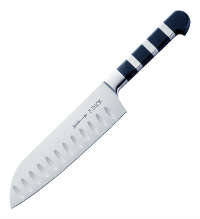
Dick knives are among some of the most popular chefs knives in the world. Complementing a huge selection of implements are sharpening steels and other accessories such as fishbone tweezers. The 18cm santoku Knife from Dick, for example, incorporates the Japanese style with high quality German steel, making it one of the toughest knives on the market.
SHOP DICK KNIVESGlobal Knives
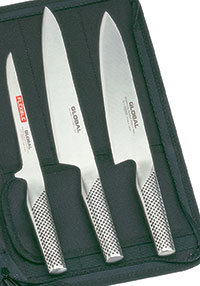
A premium kitchenware brand, the two most innovative features of knives from Global are their razor sharp edge and weighted handle. The majority of the Global knives are sharpened or ground on both sides of the blade, just like Western style knives. However, their edges are ground steeply to a point and to an acute angle.
To balance their knives, Global uses a hollow handle which is then filled with just the right amount of sand to create the perfect balance, making it feel comfortable in the hand. Global uses this method rather than using a full tang and a bolster to balance their knives. Global knives are made from the finest high carbon stainless steel available for producing professional quality kitchen knives.
SHOP GLOBAL KNIVESTsuki Knives
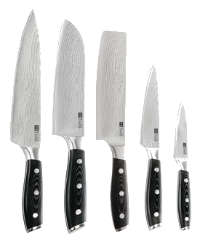
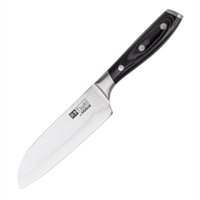
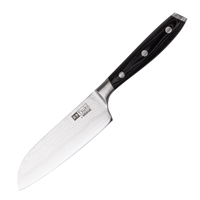
Chefs knives from Tsuki feature a Japanese VG-10 stainless steel core hardened up to 60° Rockwell rating. They provide a great cutting performance for longer. While two layers of attractive damask steel, which is a hard resilient steel often decorated and used for sword blades, covers the core to protect against corrosion.
All Tsuki knives are endorsed by the Craft Guild of Chefs ensuring premium quality, craftsmanship and a long life.
SHOP TSUKI KNIVES