
Know Your Knives Infographic
To a chef, knives are one of the most used and essential pieces of equipment in the kitchen, meaning that making the right choice between material, purpose and brand is crucial. You can pick up your knives individually or as part of a knife set. This guide explains our broad collection of styles and materials, helping you to make an informed decision when choosing the right knife for the job.
From santoku and filleting knives, to carving and utility knives, Nisbets offer models from a variety of brands such as Victorinox, Tsuki, and Hygiplas, giving you a wide range of options when selecting style, superiority and cost.
shop all knives now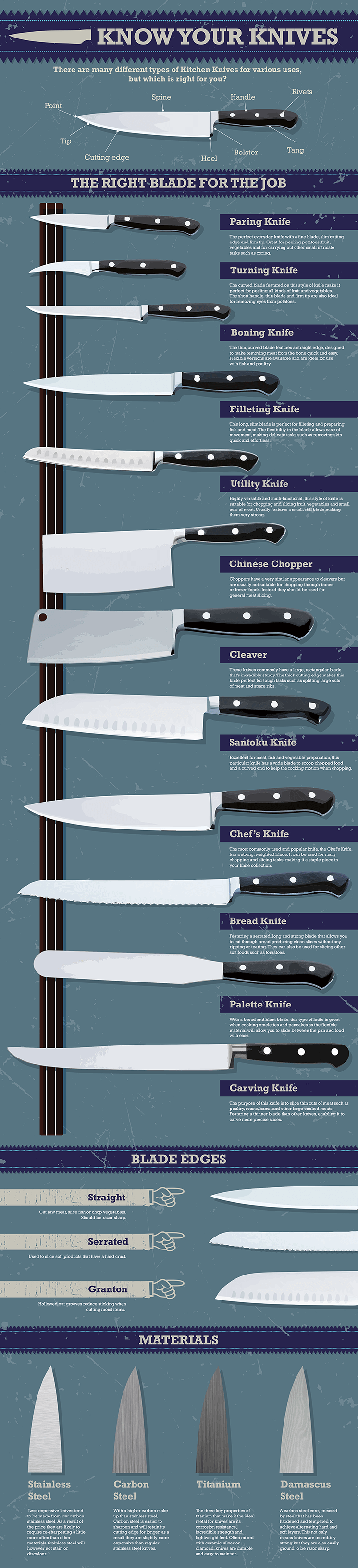

Know Your Knives
Knives are one of the most essential tools in the kitchen. A chef can have the same knife for 20 years – it’s all about reliability. But which knife is right for you? There many different kinds, made from different materials with different edges. Here at Nisbets we are committed to giving you the best information so that you can make an informed decision.
As well as the different styles, there are also different brands. From Victorinox, Tsuki and Hypiglas, we have a wide range of knives available no matter your preferences for style, superiority or cost.
There are several different parts of the knife (see the infographic for a visualisation):
- Point
- Tip
- Cutting edge
- Heel
- Bolster
- Tang
- Rivets
- Handle
- Spine
Different types of knife perform different functions.
Chef Knives are the most commonly used and popular knife. The have a strong, weighted blade. They can be used for many chopping and slicing tasks, making chef knives a staple piece in your knife collection.
Paring Knives are the perfect everyday knife with a fine blade, slim cutting edge and firm tip. They're perfect for peeling potatoes, fruit, vegetables and for carrying out other small intricate tasks such as coring.
Boning Knives have a thin, curved blade with a straight edge to make removing meat from the bone a quick and easy job. Flexible versions are available and are ideal for use with fish and poultry.
Filleting Knives feature a long, slim blade and are made for filleting and preparing fish and meat. The flexibility in the blade allows ease of movement, making delicate tasks such as removing skin quick and effortless.
Utility Knives are highly versatile and multi-functional. This style of knife is suitable for chopping and slicing fruit, vegetables and small cuts of meat. Usually features a small, stiff blade for extra durability.
Choppers are incredibly similar looking to cleavers but are usually not suitable for chopping through bones or frozen foods. Instead, they should be used for general meat slicing.
Cleavers commonly have a large, rectangular blade which is incredibly sturdy. The thick cutting edge makes this knife perfect for tough tasks such as splitting large cuts of meat and spare ribs.
Santoku Knives are perfect for meat, fish and vegetable preparation. This knife has a wide blade to help scoop chopped food, as well as a curved end to help the rocking motion when chopping.
Bread Knives feature a serrated, long and strong blade that allows you to cut through bread and create clean slices with no ripping or tearing. They can also be used for slicing other soft food like tomatoes.
Palette Knives feature a broad and blunt blade and are great when cooking omelettes and pancakes. Their flexible material allows you to slide between the pan and flood with ease.
Carving Knives are designed to slice thin cuts of meat such as poultry, roasts, hams and other large cooked meats. They feature a thinner blade then other knives, enabling them to carve more precise slices.
There are three different types of blade edges:
- Straight: Cut raw meat, slice fish or chop vegetables. Razor sharp.
- Serrated: Used to slice soft products that have a hard crust.
- Granton: Hollowed-out grooves reduce sticking when cutting moist items
There are four different types of materials that knives are made from:
- Stainless Steel: Less expensive knives are often made from low carbon stainless steel. Due to the lower cost they are likely to require re-sharpening on occasion, but a major benefit is they won’t stain or discolour. Stainless steel is usually easy to wipe clean.
- Carbon Steel: With a higher carbon make up than stainless steel, Carbon steel is easier to sharpen and will retain its cutting edge for longer. These added benefits usually means a slight increase in price.
- Titanium: The three key properties of titanium that make it the ideal metal for knives are its corrosion resistance, incredible strength and lightweight feel. Often mixed with ceramic, silver or diamond, these knives are durable and easy to maintain.
- Damascus Steel: A carbon steel core, encased by steel that has been hardened and tempered to achieve alternating hard and soft layers. This not only means knives are incredibly strong but they are also easily ground to be razor sharp.
Article: See our buying guide on choosing the perfect knife for you.