An eco-friendly approach to food – Root to Fruit Dining
The growing calls to reduce food waste are driving some chefs to get creative in a bid to slash what they throw away, fuelling a new movement known as root to fruit.
Root to fruit (or root to stem) dining is a food philosophy that encourages people to think, not just about the provenance of their food, but its environmental impact, from the growing or rearing stage to the moment it reaches your plate and beyond.
So is root to fruit just a passing fad or does it signal a sea change in the way chefs manage their menus? We speak to one of the campaign’s leading lights, Tom Hunt, co-founder and executive chef at Poco in Bristol, about the movement’s background and how to reduce waste.
Read on to find out more.
What are the origins of root to fruit eating?
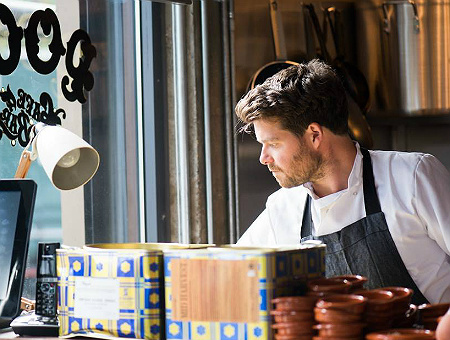
In the UK at least, the movement’s beginnings lie in a pop-up restaurant event called Feast on the Bridge, which took place annually on London Bridge between 2007 and 2011.
In its final year, food waste activists Eloise Day and Emily Elgar teamed up with eco-chef Tom Hunt to serve up a menu using sustainably-caught fish, unwanted vegetables and stale bread from local bakers.
For Hunt it was a turning point - one that led him to work with food campaigner, Tristram Stuart, and make the move towards a more sustainable way of working, which he dubbed 'root to fruit'.
“I coined the term in 2010/11 when I started working in food waste. I saw the global food waste scandal as an opportunity to start the conversation about climate change and food sustainability,” he says. “Root to fruit eating is a food sustainability philosophy with three key principles. They are:
✔ To eat for pleasure
✔ To eat whole foods
✔ To eat the best food you can
“What root to fruit eating does is help enable home cooks or industry chefs to help to support a regenerative food system for no extra cost."
At the same time as Tom Hunt was developing his root to fruit philosophy, a similar approach was percolating on the other side of the Atlantic.
Dan Barber, owner and chef of New York’s Blue Hill restaurant had what he calls his “a-ha moment” whilst writing his book The Third Plate, published in 2014.
Speaking to the Foodservice Consultants Society (FCSI) web site he said: “The world’s greatest cuisines all stem from a ‘waste not’ mentality. It was partly out of necessity, of course – they didn’t have the same luxury of throwing away parts of the animal or the vegetable – but it came out of culinary curiosity, too.”
Inspired, he launched WastEd (short for ‘waste education’), a three-week, pop-up event staged at his Greenwich Village restaurant in March 2015 that showcased a menu made entirely of ingredients gathered on what the New York Times dubbed “a crosstown refuse hunt”.
What is root to fruit dining?
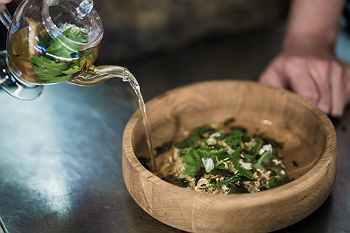
For Tom Hunt the philosophy of root to fruit is not just about keeping food out of the bin, it’s also about the whole process from farming to consumption.
“It starts with supporting the whole farm, because any particular farm should really be growing ingredients in rotation, and that are appropriate for the landscape.
“So ‘eating the best food you can’, means eating affordably, because good food needs to be accessible and affordable for it to be sustainable.
“The recipe I normally do for that is a whole wheat, spelt soda bread, because you’re using whole wheat flour, so it’s the whole plant; and you’re using spelt, which is a better crop for the soil than wheat, because it has a longer root structure.
“The second one is ‘eat whole foods’, so taking that word ‘whole’ quite literally. I might do something like a shaved carrot and fennel salad with a chimichurri or a pesto, from the fennel fronds and the carrot tops and stalks. I wouldn’t be peeling those vegetables and therefore I’d make sure I was buying organic.”
“The final dish that I do to describe ‘eat for pleasure’ is a single origin chocolate truffle, which is really talking about how important the origin of our food is and how the terroir and the biodiversity of where our food grows affects not only its flavour but the environment too.
“Each point really is interconnected with the other. So eating for pleasure is also about zero waste, because if you truly love what you’re cooking, you’ll value it and waste less.”
What’s the difference between root to stem and root to fruit cooking?

Though both grew out of a desire to cut food waste, Hunt believes the root to fruit approach has morphed into something greater, encompassing seasonality and locality, but also understanding the value of food because of the amount of work that goes into producing it.
“Root to fruit eating began as a zero waste philosophy that quite quickly grew into a holistic approach to food sustainability.”
“Waste is only one of the issues around climate change and the environment - it’s far broader than that. Other people have coined similar terms, like root-to-stem, which I think is more zero waste focussed.”
“So although root to fruit eating is a zero waste philosophy, it’s blossomed into far more than that.”
Dan Barber also believes a change is needed if we are to avoid a global food crisis.
“Our industrial food system not sustainable in the long run,” he told the FCSI. “The challenge for the future is to create a more holistic way of farming and eating, just as traditional food cultures did for hundreds of years.”
For him that means not just eating less meat but focussing on growing more flavourful vegetables and making them the centrepiece of every plate. To this end he established a seed company, Row 7, with Michael Mazourek and Matthew Goldfarb. Its goals were to focus on developing varieties of vegetables that produced not only a good harvest but were also delicious.
Their first collaboration produced the honeynut squash, a palm-sized version of a standard squash that packs an intense sweet and nutty flavour, and which entered the seed market in 2015.
Article: Want to discover more about food provenance? Our article on the importance of locally sourced ingredients contains all you need to know about the farm-to-fork movement.
The nose-to-tail influence
The most obvious influence on the root to fruit philosophy is the nose-to-tail cooking trend, in which every part of an animal carcass is used.
Though a modern phenomenon, it's a tradition that stretches way back into pre-history.
By the medieval period it had become common for households to rear their own animals for food, particularly pigs. They would be fed on leftover vegetables before being slaughtered and the various parts, including the offal, used in dishes such as brawn (the head and trotters), mock goose/hog maw (the stomach), black pudding (fat and blood) and white pudding (fat and liver) – food that’s still familiar to many of us today.
Across the world peasant food recipes such as barbacoa (slow cooked animal head), coq-au-vin (rooster in wine) and boeuf bourginon (beef in wine) allowed the cash-strapped to transform tougher meat into tender, wholesome meals, by braising it slowly in an oven. These dishes have, in turn, given rise to many food fusions over the centuries.
Well into the early 80s - when cuts we regard as affordable and commonplace today were still too expensive for many tables - tongue, liver, kidney, tripe and oxtail were still staples of Britain’s tea-time table.
By the time Fergus Henderson opened his restaurant, St John, at Smithfield, London, in 1995 – coining the phrase ‘nose-to-tail’ in the process - they had all but disappeared from the menu, but his dazzlingly bold recipes helped usher in a new era in food.
What’s so different about root to fruit?
At first glance you could be forgiven for thinking this a case of the emperor’s new clothes.
After all, there are recipes throughout food history that take leftovers and elevate them into a whole new dish – think arancini, bubble and squeak or coq au vin, so called ‘peasant dishes’.
And tackling food waste has been at the top of of the agenda for many chefs in the past few years.
Recent high profile campaigns by the likes of Hugh Fearnley-Whittingstall and Jamie Oliver have seen the fight against food waste taken to those who can really make a difference. Whittingstall’s controversial campaign brought to an end the practise of discarding fish catches, while Oliver succeeded in convincing supermarket giant Asda to begin selling misshapen veg.
But the difference with root-to fruit is that it isn’t about big gestures. It’s about respecting and maintaining good soil, and ensuring food is well-farmed. It’s about the part everyone can play, not just by reducing waste but also by shopping locally and seasonally. And, as Tom Hunt says, it’s also about chefs taking the use of ingredients a step further.
“(In the past) we wouldn’t always have used carrot tops necessarily, or not everyone would have. The new movement is kind of revisiting old techniques and learning from the past but also with a contemporary eye.”
‘Instrumental ingredients’
For those unfamiliar with the root to fruit approach it’s surprising just how many ways there are to use the parts or vegetable that would normally be thrown away.
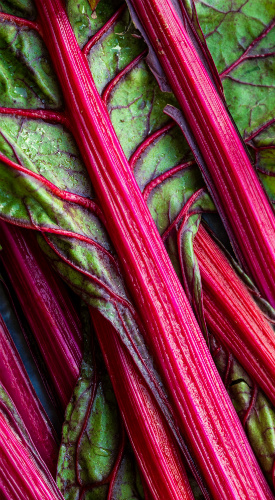
Broccoli, chard and asparagus stems can easily be turned into pickles, while potato skins can be chopped into fries or roasted with olive oil and rosemary. Carrot tops, finely chopped, can add crunch to salsas and chimichurris or give greater depth of flavour to stocks or soups.
The concept is even beginning to gain currency in the mainstream. The website of supermarket giant Tesco already has a page dedicated to root-to-stem cooking, including recipes for Thai green fish curry, miso squash ramen and three citrus marmalade.
Poco’s Tom Hunt, along with his team of head chef Ian Clark and partners Ben Pryor and Jen Best, continues to lead the charge when it comes to root to fruit eating, but the past few years have seen other chefs adopt his approach and experiment with ever more innovative ways of using every last scrap.
For Dan Barber that means discarded outer leaves from heads of bak choi and peelings of kohlrabi, apples and fennel become the ‘Dumpster Dive Vegetable Salad’, while pasta remnants are boiled together and dressed with a fish sauce made from monkfish tripe and smoked fish heads.
Merlin Labron-Johnson formerly of London’s esteemed Clipstone and Portland restaurants, spoke in 2017 of drying the skins of baked celeriac and blending it to make salt for his restaurants. Asparagus peelings were fermented into a sour juice, which was used as a replacement for lemons; while carrots that had gone soft were pickled with mustard seeds.
Writing for the Evening Standard he said: “Although these are not glamourous enough to feature in descriptions on our menus they are instrumental ingredients in each dish.”
“It’s as much an ethical approach as it is an attempt to be economically astute as a business – why discard something when it can replace an ingredient we have to pay for?”
So, as the gaze of the food industry and the public shifts towards green issues and more sustainable ways of living, the pioneers of root to fruit are already showing us we can make an impact simply by being more mindful in our approach to what we eat.