
Which Bin Bag Do I Need?
When buying bin bags, there are three key factors you need to consider.
The first of those is the type of bin bag you need. Bin bags are made in a variety of colours and from different materials. This determines what waste is going to be put in them, and how they will be disposed of.
The second factor to consider is the size of bin bag you need. It’s important that you find the right size bag to ensure you make the most of the space in your bins.
The final factor is the weight and quantity of waste going into your bin bags. To prevent rips and spills, it’s vital you choose a bin bag that is strong enough to handle the weight of your refuse.
Show Me Bin BagsWhat type of bin bag do I need?
To find the best type of bin bag for your needs, you need to think about how you segregate and dispose of your waste. Whether you’re disposing of general rubbish, recyclable materials or food waste, there’s a type of bin bag to suit.
The main types of bin bag are:
- Black Bin Bags
- Clear Bin Bags
- Coloured Bin Bags
- Bin Liners
- Compostable Bin Liners
Black Bin Bags

No matter how hard you try, there will always be materials in your waste that cannot be recycled. This rubbish is called general waste, or ‘residual waste’, and should be disposed of in black bin bags.
Examples of general waste include:
- Contaminated food packaging
- Sweet wrappers and crisp packets
- Polystyrene
- Tissues
- Floor sweepings
TIP: Polystyrene is generally not accepted for recycling. Speak with your waste collection service provider to see if they will collect it.
General waste is usually sent to landfill sites and is often the most expensive way to dispose of your rubbish. With the current landfill tax sitting at £88.95 per tonne (as of April 1st 2018), you should try to use non-landfill waste management options, such as recycling and composting, wherever possible.
Using these non-landfill solutions will not only save your business money, but also reduce your environmental impact.
Take Me To Black Bin BagsClear Bin Bags
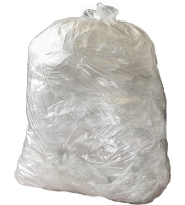
One of the most popular uses of clear bin bags is as part of a dry mixed recycling system (also known as ‘co-mingled recycling’).
A dry mixed recycling system is where a wide range of uncontaminated recyclable materials are all disposed of into one single recycling bin. These mixed materials are then collected and sent to a materials recovery facility (MRF) where they will be segregated into different waste streams and recycled separately.
Some of the most common types of material used in a dry mixed recycling system include:
- Paper - newspapers, office paper and magazines
- Cardboard - corrugated cardboard and card
- Plastic – clean drinks bottles, salad trays and microwavable meal trays
- Metal – clean drinks cans and food tins
Many waste management services will refuse to collect recyclable materials that are not stored in clear or tinted bin bags. Collection services need to see that all the materials are recyclable and not mixed in with general waste. Clear bin bags enable this visual check, while a black refuse sack would prevent it.
Because all the materials are disposed of into one single container, there is no need for colour-coded segregation. Therefore, clear bin bags make the best choice for dry mixed recycling systems.
Clear bin bags are also preferred for the disposal of general waste in many retail and hospitality businesses, as well as high security environments such as airports, train stations and shopping centres. The clear material helps to prevent the theft of valuable merchandise and allows suspicious items to be easily identified.
Take Me To Clear Bin BagsColoured Bin Bags
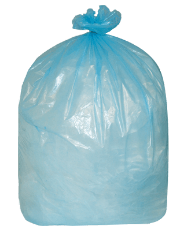
If you produce a large quantity of one or more recyclable materials, it is often more cost-effective to segregate each type into separate waste streams on-site – rather than using a dry mixed recycling system.
While this waste segregation can be achieved with a clear refuse sack, coloured bin bags help to ensure the right material is disposed of into the right bag. This reduces the risk of general rubbish and incorrect materials contaminating the recycling process.
There is no hard and fast rule for recycling colours. If you are looking to dispose of any recyclable material into its own waste stream, you should use whatever coloured bins you already have and match the bin bag colour to suit. We offer a range of coloured bin bags - including red, blue, green and yellow sacks - that are all ideal for use with your coloured bins. Using colour-coded lids and stickers will also help to teach your staff and customers which material matches which colour.
Coloured bin bags are also tinted so that, like clear bin bags, the contents can be easily viewed by waste management services when collecting your refuse.
Bin Liners
The difference between bin bags and bin liners is that a bin bag is stronger and generally larger than a bin liner. Bin liners are designed to keep your bins clean and hold a small amount of waste. As such, they are often used with small pedal and swing bins in guestrooms and hotel bathrooms, as keeping the bin hygienic is important to customer satisfaction and well-being.
Compostable Bin Liners
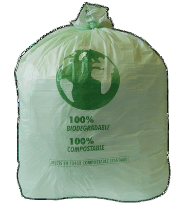
Compostable bin liners, also known as ‘food waste bags’ or ‘caddy liners’, are made for use with leftover and wasted food – making them an essential for any restaurant, café, pub or bistro. Compostable bin liners allow your staff to easily segregate food waste from general rubbish and dispose of it in an environmentally-friendly way.
Some of the most common types of food waste suitable for commercial compostable bin liners include:
- Plate scrapings and leftovers
- Fruit and vegetable waste
- Old bread and pastries
- Grains and pasta
- Coffee grounds and tea leaves
- Crushed egg shells
TIP: The items that can go in your compostable bin bags will vary depending on the method (in-vessel composting vs. windrow composting) used to turn your organic waste into compost. For example, some facilities using enclosed composting methods will accept meat as a form of organic waste. Facilities using other methods may not. Speak with your waste management supplier to clarify what can and cannot be put in your caddy liners.
Made entirely from plant-based materials such as corn starch, these bin bags can be fully composted with your food waste.
When collected by waste management services, the food waste bags will usually be taken to a commercial composting facility. There, they will be shredded alongside the food waste and exposed to controlled air circulation, temperature and moisture. This process will create nutrient-rich compost that can be used in agriculture to grow more food.
Depending on your waste management service, these caddy liners can even be taken to anaerobic digestion plants where the methane produced from the breaking-down process can be used to generate energy.
TIP: Many of our eco-friendly disposables are suitable for commercial composting – perfect for those wanting to improve their green footprint.
Take Me To Compostable Bin LinersWhat size bin bag do I need?
To make the most of the space in your bins, it’s important that you find the correct size bag. Picking too big a bin bag will result in an unsightly overhang and needless added costs. Picking too small a bag means it may not fit the bin at all, or leave insufficient room for tying and carrying.
TIP: If you can’t find a bag to match the exact size of your bin, you should always choose a larger sack over a smaller one to ensure it will fit your waste container.
To find the correct size sack for your bins, it’s important that you understand the three measurements used to calculate the dimensions of a bin bag.
These three measurements are the face width, open width and length.
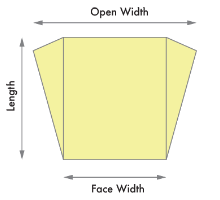
The face width is the sealed, closed width of the bottom of your bin bag. The open width is the maximum width of the bin bag when it is stretched from one side to the other. The length is simply the measurement from the top to the very bottom of the bin bag.
With these three measurements, you can work out what size bag you need for your bins.
TIP: All of our bin bags state the face width, open width and length – saving you time and effort on measuring.
What size bin bag for my round bins?
To find the correct size bin bag for your round bins, there are two simple steps you need to take.
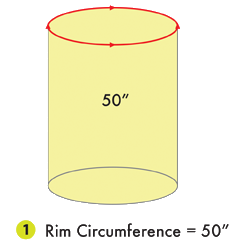
- Measure the circumference of your bin. The circumference is the length of the edge around a circle – in this case the length all the way around the rim.
- Then divide the circumference by two. The resulting number is the open width dimension you need for your bin bag.
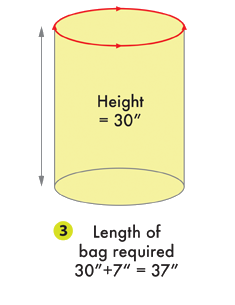
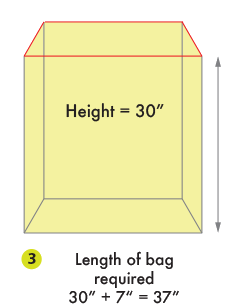
- Measure the height of your bin from top to bottom. Add approximately 7” onto the height to find the length of bin bag you need. This extra 7” allows for an overhang which stops the bag falling in the bin and gives you plenty of room for tying.
TIP: A simple way to calculate the circumference of your bin is to find the diameter (the width from one side to the other) and multiply this by 3.14 (pi).
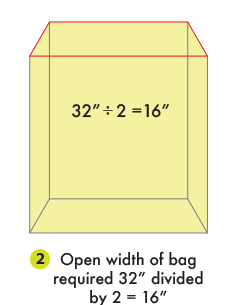
As an example, if your bin has a 50” circumference, you must divide this by two – giving you 25”. Therefore, the open width of your bin bag should be 25”. If your bin is 30” tall, you will need a sack with a 37” length.

What size bin bag for my square and rectangular bins?
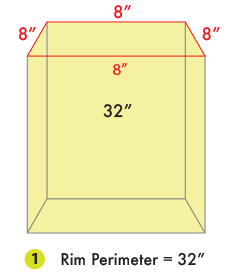
To find the right bin bag for your square and rectangular bins you must add up each of its sides and divide by two.
- Calculate the perimeter - the total measurements of all the sides of your bin.
- Divide the perimeter of your bin by two. The resulting number is the open width you need for your bin bag.
- Measure the height of your bin and add roughly 7” onto the total to allow for a good overhang and easy tying.
Choose your weight requirements
To avoid rips and tears when transporting waste around your venue, it’s essential you pick a bin bag that is strong enough to handle the weight of your rubbish.
All our black, clear and coloured bin bags work to the CHSA (Cleaning and Hygiene Suppliers Association) accredited weight capacity system. This accreditation ensures the bags can conform to a weight drop test and puncture, ripping and tearing measures.
TIP: Bin liners and compostable bin liners are not governed by the CHSA weight testing accreditation as they are not designed for heavy use.
Each bag is given a CHSA rating. These ratings are the maximum weight capacity each bag can hold in kilograms, and range from the light-duty 5kg bin bags to the extra heavy-duty 20kg sacks.
For most businesses, a 5kg or 10kg bag will be perfect for day-to-day use. However, if you are disposing of heavy waste, a 20kg sack may be better suited. Consider what kind of waste will go into your refuse sack and judge the weight that each bag will need to hold.
| Maximum Weight Capacity | Best Suited For | Waste Examples | |
|---|---|---|---|
| Light-Duty Bin Bags | 5kg | Paper and General Office Waste |
|
| Medium-Duty Bin Bags | 10kg | Domestic Waste and Segregated Recycling |
|
| Heavy-Duty Bin Bags | 15kg | Catering Waste |
|
| Extra Heavy-Duty Bin Bags | 20kg | Trade and Industrial Waste |
|
TIP: Carrying upwards of 15kg can be a strenuous task for your staff. Ensure all your workers are fully trained in manual handling procedures to prevent injuries and accidents.
Frequently Asked Questions
What is a bin bag gauge?
The gauge of a bin bag refers to how thick it is - the greater the gauge, the thicker the bag. Many people believe that the strength of a bin bag is determined by how great its gauge is.
This is a common mistake.
Some manufacturers use chalk dust to bulk up the polythene when producing their bin bags. This makes the bag brittle and prone to ripping whilst giving the perception that the film is thick and strong.
Luckily, all of our black, clear and coloured bin bags are CHSA-accredited. This accreditation gives you a guarantee that each bin bag will be able to safely hold its specified maximum weight capacity.
Are bin bags recyclable?
Yes. Both reprocessed and virgin (newly-manufactured) polythene bin bags can be recycled after use. Some waste management services will accept used bin bags for recycling as their cleaning processes are thorough enough to remove any contamination.
While black bin bags are usually sent to landfill sites, there are instances where general waste is removed from the bags and sent for incineration – leaving the black bin bags free for recycling. However, black bin bags are coloured using carbon black pigments. This means that the infra-red technology used to sort plastic in materials recovery facilities cannot detect them. Therefore, our black bin bags cannot be recycled unless manually segregated from other waste. Speak with your waste management service to see if they will manually sort your black bin bags for recycling.
Clear and colour-tinted bags can be detected by these infra-red scanners, making them suitable for recycling without the need for manual segregation.
TIP: You should always check with your waste management service first before sending your bin bags for recycling. Many waste management contractors will differ in what they accept for recycling.
Are bin bags food safe?
Generally, bin bags are not food safe. It is not advisable to store food for human consumption in your bin bags.
Firstly, it is not possible to guarantee the level of contamination present in the scrap polythene used to make recycled polythene bin bags.
Secondly, virgin polythene bags may not have been manufactured in a food safe environment. Therefore, they may have been contaminated by their surroundings – making them unsafe for use with food.
It is always best to use a bag that is marked ‘Food Safe’ for storing any food that will come into human contact.
TIP: Our wide range of food storage solutions is perfect for storing your ingredients in a safe and hygienic way.
Are bin bags flammable?
Polythene bin bags are flammable, so it is vital that you store them in cool, dry conditions to remove any possible fire hazards. Ensure hot items, such as cigarettes, hot embers and hot ash are never placed in your bin bags.
How should I store compostable bin liners?
Compostable bin liners are designed to break down in warm, moist conditions. Therefore, you should store them in cool, dry and dark environments to prevent them from degrading.
Compostable bin liners have a shelf life of around 18 months. Therefore, much like food, you should monitor your stock closely.
Shop all bin bags now

